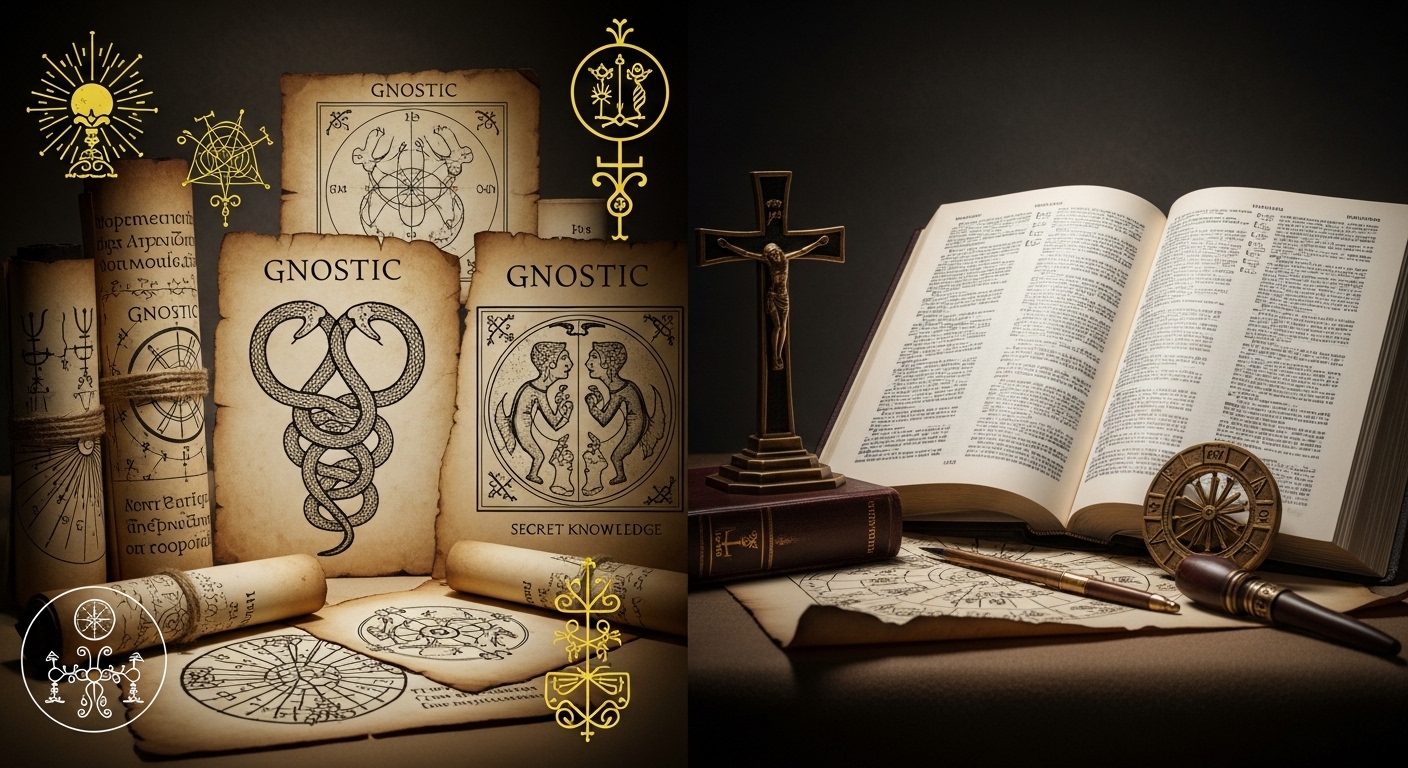
You want to understand Christian history and theology clearly, discerning truth from error.
But you’ve encountered the problem that confusing references to “Gnosticism” in church history books, documentaries, or debates leave you uncertain about what this ancient movement actually taught.
You need clarity on what gnosticism is in Christianity. Early church fathers become your guides, showing how this heretical movement threatened orthodox Christianity fundamentally.
Discover Gnosticism’s core beliefs, examine how it contradicts biblical teaching, and understand why early Christians fought it vigorously.
This guide will help you recognise Gnostic ideas persisting in modern spirituality, for without proper understanding, you risk embracing similar heresies unknowingly.
But what the early church fathers discovered about Gnosticism’s dangers could protect your faith from subtle deceptions still circulating today in seemingly Christian forms.
Definition of Gnosticism
Gnosticism represents a complex religious movement that emerged in early Christianity, fundamentally contradicting orthodox Christian theology while claiming superior spiritual insight.
Meaning of “Gnosis” – The term derives from Greek gnosis, meaning “knowledge.” Gnostics claimed special, secret knowledge about God, creation, and salvation unavailable to ordinary believers.
This wasn’t intellectual knowledge but mystical insight supposedly revealing hidden divine truths and humanity’s spiritual origin, distinguishing the spiritual elite from the ignorant masses.
Esoteric Religious Movement – Gnosticism functioned as an esoteric movement teaching salvation through secret knowledge rather than the public gospel.
Various Gnostic sects proliferated during Christianity’s early centuries, each claiming exclusive access to hidden teachings allegedly passed down from the apostles in private.
This elitism contradicts Christianity’s universal gospel accessible to all.
2nd-Century Development – While proto-Gnostic ideas existed earlier, fully developed Gnostic systems emerged prominently in the 2nd century, producing texts like the Gospel of Thomas and the Gospel of Judas.
Church fathers such as Irenaeus, Tertullian, and Hippolytus wrote extensively to refute Gnostic teachings and defend orthodox Christianity against these sophisticated heresies.
What Is Gnosticism in Christianity?
Gnosticism is a heretical movement that emerged in early Christianity (primarily 2nd-3rd centuries), teaching that salvation comes through secret mystical knowledge (gnosis) rather than faith in Christ’s atoning work.
Gnostics believed the material world is inherently evil, created by an inferior divine being (demiurge), not the supreme God.
They taught humans possess a divine spark trapped in evil matter, and salvation means escaping physical existence through esoteric enlightenment rather than bodily resurrection.
Gnosticism denied Christ’s true incarnation (Docetism—claiming Jesus only appeared human), rejected the goodness of God’s creation, and contradicted core Christian doctrines about salvation by grace through faith.
Early church fathers vigorously opposed Gnosticism as a fundamental distortion of the gospel, emphasising that salvation comes through Christ’s death and resurrection, not secret knowledge.
Gnosticism represents radical dualism (spirit good, matter evil) versus Christianity’s affirmation of creation’s goodness, physical resurrection, and incarnation.
While ancient Gnosticism declined after the 4th century, similar ideas persist in New Age spirituality, emphasising hidden knowledge, creation’s evil, and salvation through enlightenment rather than Christ’s finished work.
Gnosticism Origin
Gnosticism’s origins remain debated among scholars, but the movement clearly emerged from complex interactions between early Christianity, Greek philosophy, and Eastern religious ideas.
Philosophical Influences – Gnostic thought drew heavily from Platonic dualism, distinguishing the eternal spiritual realm from the inferior material world.
Greek philosophical concepts about matter’s evil nature, the soul’s divine origin, and knowledge as a path shaped Gnostic cosmology.
Persian dualism (Zoroastrianism), emphasising cosmic conflict between good and evil, also influenced Gnostic systems.
Jewish Apocalyptic Elements – Some Gnostic texts incorporated Jewish mystical traditions, reinterpreting Genesis creation accounts negatively and portraying the Old Testament God as an ignorant or malevolent creator.
This represented a radical departure from Jewish monotheism while appropriating Jewish scriptures for Gnostic reinterpretation, supporting dualistic cosmologies.
Christian Context – Gnosticism developed within Christian communities, claiming apostolic authority while teaching doctrines contradicting apostolic teaching.
Gnostic teachers like Valentinus, Basilides, and Marcion operated within Christian churches initially, producing alternative gospels and epistles claiming secret knowledge from Jesus or apostles. This internal threat made Gnosticism particularly dangerous to early Christianity.
2nd-Century Formalisation – While proto-Gnostic ideas existed earlier, formal Gnostic systems with elaborate cosmologies, mythologies, and texts emerged primarily in the 2nd century.
The discovery of the Nag Hammadi library in 1945 provided extensive primary sources revealing Gnosticism’s diversity and complexity beyond the church fathers’ polemical descriptions.
Core Beliefs of Gnosticism (Gnosticism Beliefs and Practices)
Gnostic systems varied significantly, but common theological themes united diverse sects under the Gnostic umbrella despite differences in mythology and practice.
Radical Dualism – Gnosticism taught absolute opposition between spirit (good) and matter (evil). Unlike Christianity, affirming creation’s goodness despite sin’s corruption, Gnostics viewed material existence as an inherently evil prison.
Salvation meant escaping physical reality, not redeeming it. This dualism produced ascetic practices rejecting bodily pleasures or libertine practices dismissing physical actions as spiritually irrelevant.
Material World as Evil – Gnostics believed the physical universe resulted from a cosmic mistake or malevolent act, not God’s intentional creation.
The Genesis creation account was reinterpreted negatively—creation represents imprisonment of divine sparks in evil matter. This contradicted Genesis 1’s repeated affirmation that creation is “good.”
Divine Spark in Humans – Gnosticism taught that some humans (pneumatics/spiritual ones) possess a divine spark—a fragment of the supreme God trapped in a material body.
Salvation meant awakening this inner divinity through gnosis, recognising one’s true spiritual nature. Others (hylics/material ones) lacked a divine spark, remaining irredeemably bound to matter.
Salvation Through Secret Knowledge – Unlike Christianity teaching salvation through Christ’s death and resurrection received by faith, Gnosticism taught salvation through esoteric knowledge revealing humanity’s divine origin.
This knowledge wasn’t intellectual but mystical enlightenment, freeing the divine spark from material imprisonment. Only the spiritual elite could receive and comprehend this hidden wisdom.
What Do the Gnostics Believe In?
Gnostics believe in salvation through secret mystical knowledge (gnosis), revealing humanity’s divine origin and escape from evil material existence.
They teach a supreme, unknowable God separate from the creator of this world, who is an inferior divine being (demiurge)—often identified with the Old Testament God.
Gnostics believe matter is inherently evil, the physical world is a prison, and some humans possess a divine spark trapped in material bodies.
Salvation means awakening this inner divinity through esoteric enlightenment, not through Christ’s atoning sacrifice.
Gnostics typically deny Christ’s true incarnation (Docetism), claiming Jesus only appeared human because divinity couldn’t truly unite with evil flesh.
They reject bodily resurrection, viewing it as returning to material prison rather than glorious transformation. Gnostic cosmology includes complex hierarchies of divine beings (aeons) emanating from the supreme God, with the demiurge creating the material universe ignorantly or malevolently.
Salvation involves ascending through these spiritual realms, shedding material existence, and reuniting with the divine source through knowledge rather than grace, contradicting Christianity’s core doctrines.
Gnostic View of God and Creation
Gnostic cosmology fundamentally contradicts Christian theology by distinguishing the supreme God from the creator, producing elaborate mythologies explaining the material world’s existence.
The True Supreme God – Gnostics taught an ultimate, unknowable, transcendent God—utterly separate from creation, beyond description or comprehension.
This supreme deity didn’t create the material world, remaining completely removed from physical existence.
Some systems call this being the Monad, Bythos (Depth), or simply the Unknown Father, emphasising absolute transcendence.
The Demiurge as Creator – The material world resulted from a lesser divine being’s actions—the demiurge (craftsman). Gnostics often identified this creator with the Old Testament God (YHWH), portraying him as ignorant, arrogant, or malevolent.
The demiurge created the physical universe, believing himself supreme, ignorantly trapping divine sparks in evil matter.
Hierarchies of Divine Beings – Between the supreme God and material creation existed complex hierarchies of divine emanations (aeons)—spiritual beings proceeding from the ultimate deity.
These aeons represented divine attributes or stages of emanation. The material world resulted from disorder or rebellion within this divine hierarchy, not intentional creation by the supreme God.
Gnostic View of Jesus Christ
Gnostic Christology radically departed from orthodox teaching, denying incarnation while claiming Jesus revealed secret knowledge rather than accomplishing redemption.
Jesus as Revealer, Not Redeemer – Gnostics viewed Christ primarily as a teacher revealing hidden knowledge about humanity’s divine origin and the material world’s evil nature.
He didn’t die for sins or accomplish redemption through atoning sacrifice. Instead, he descended to awaken divine sparks through gnosis, teaching escape from material prison.
Docetism (Denial of True Incarnation) – Most Gnostic systems taught Docetism—Christ only appeared human without truly becoming flesh.
Since matter is evil, a divine being couldn’t genuinely unite with a physical body. Jesus either possessed only an apparent body (a phantom) or the divine Christ temporarily inhabited human Jesus, departing before crucifixion. This contradicted John 1:14: “The Word became flesh.”
Hidden Teachings – Gnostics claimed Jesus taught secret doctrines to select disciples, producing alternative gospels recording these esoteric teachings.
These texts portrayed Jesus revealing complex cosmologies, mystical knowledge, and salvation through enlightenment unavailable in the canonical Gospels. This contradicted Christ’s public ministry and the apostles’ open gospel proclamation.
What Does the Bible Say About Gnostics?
While the New Testament doesn’t use the term “Gnostic” explicitly, several passages directly address proto-Gnostic errors threatening early churches.
1 John 4:2-3 combats Docetism: “Every spirit that acknowledges that Jesus Christ has come in the flesh is from God, but every spirit that does not acknowledge Jesus is not from God.”
Colossians 2:8 warns, “See to it that no one takes you captive through hollow and deceptive philosophy,” likely addressing early Gnostic-type teachings in Colossae.
1 Timothy 6:20 warns against “opposing ideas of what is falsely called knowledge [gnosis],” directly using the term that Gnostics claimed.
1 Corinthians 8:1 cautions, “Knowledge puffs up while love builds up,” addressing knowledge-based elitism.
2 John 7 warns about deceivers “who do not acknowledge Jesus Christ as coming in the flesh,” combating Docetic Christology.
The Pastoral Epistles repeatedly warn against “myths and endless genealogies” (1 Timothy 1:4) and “godless myths” (1 Timothy 4:7)—possibly referencing Gnostic cosmological speculations.
While addressing proto-Gnostic errors rather than fully developed 2nd-century systems, Scripture clearly opposes core Gnostic ideas: denying Christ’s incarnation, salvation through secret knowledge, matter’s inherent evil, and elitist spirituality.
How Gnosticism Differs from Orthodox Christianity (Gnosticism vs Christianity)
Fundamental theological differences separate Gnosticism from Christianity, making them incompatible despite Gnostic claims to represent true Christianity through secret apostolic traditions.
Public Gospel vs Secret Knowledge – Christianity proclaims openly accessible gospel—”For God so loved the world” (John 3:16)—available to all who believe.
Gnosticism teaches salvation through esoteric knowledge available only to the spiritual elite. Christianity emphasises faith; Gnosticism emphasises enlightenment. Christian salvation is a gift received; Gnostic salvation is knowledge discovered.
Incarnation Affirmed vs Denied – Christianity confesses God became truly human—”The Word became flesh and made his dwelling among us” (John 1:14).
Gnosticism denies true incarnation through Docetism, claiming the divine couldn’t unite with evil flesh. This distinction is foundational; Christianity’s entire salvation narrative depends on Christ’s genuine humanity and deity united.
Creation Good vs Evil – Christianity affirms creation’s goodness despite sin’s corruption—”God saw all that he had made, and it was very good” (Genesis 1:31). Gnosticism teaches matter is inherently evil, physical existence is prison, and salvation means escaping materiality.
Christianity anticipates bodily resurrection and renewed creation; Gnosticism seeks release from physical existence entirely.
Salvation by Grace vs Enlightenment – Christianity teaches salvation through Christ’s atoning death and resurrection, received by grace through faith (Ephesians 2:8-9).
Gnosticism teaches salvation through mystical knowledge, revealing inner divinity. Christianity emphasises what Christ did for us as an internal work; Gnosticism emphasises discovering divinity within.
For Christian perspectives on salvation, justification in the New Testament explains how believers are declared righteous through faith.
Why Do Christians Reject Gnosticism? (Why Is Gnosticism a Heresy?)
Christianity rejects Gnosticism as fundamental heresy, contradicting core biblical doctrines, apostolic teaching, and the gospel’s nature, making it incompatible with orthodox faith.
Denies Christ’s True Incarnation – Gnostic Docetism makes Christ’s sacrifice meaningless. If Jesus only appeared human, He didn’t truly suffer, die, or rise bodily.
Hebrews 2:14 insists Christ “shared in their humanity so that by his death he might break the power of him who holds the power of death.” Without real incarnation, no real redemption occurs.
Contradicts Creation Doctrine – Gnosticism’s evil matter teaching contradicts Genesis 1-2, where God repeatedly calls creation “good.”
This undermines marriage, family, work, stewardship, and physical existence. Christianity affirms material creation’s goodness while acknowledging sin’s corruption, anticipating creation’s redemption (Romans 8:19-21) rather than escape from it.
Replaces Grace with Knowledge – Gnostic salvation through enlightenment contradicts salvation by grace through faith.
This produces spiritual elitism where only intellectually capable or mystically inclined can be saved, contradicting the gospel’s universal accessibility.
Christianity declares salvation available to all who believe, regardless of intellectual capacity or mystical aptitude.
Undermines Scripture’s Authority – Gnosticism produces alternative scriptures (gospels, apocalypses) claiming apostolic authority while contradicting canonical texts.
This relativises biblical authority, making personal mystical experience superior to apostolic testimony. Christianity grounds faith in apostolic witness preserved in Scripture, not private revelations.
Promotes Moral Relativism – Gnostic dualism produces either severe asceticism (punishing evil body) or libertinism (physical actions spiritually irrelevant).
Christianity teaches holistic ethics—body and soul both matter, requiring righteous living reflecting God’s character in all dimensions of existence, not just spiritual/intellectual realms.
Early Church Response to Gnosticism
The early church fought Gnosticism vigorously, developing theological tools and ecclesiastical structures that defined orthodox Christianity against heretical alternatives.
Apostolic Tradition – Church fathers emphasised apostolic succession—teachings passed directly from apostles through recognised bishops.
Against Gnostic claims of secret traditions, orthodox Christianity insisted on public apostolic teaching preserved in churches founded by apostles.
Irenaeus particularly stressed this argument, tracing episcopal succession demonstrating doctrinal continuity.
Formation of Canon – The New Testament canon formed partly in response to Gnostic alternative scriptures.
The church identified which texts genuinely represented apostolic teaching versus later fabrications.
Criteria included apostolic authorship/connection, consistency with recognised apostolic doctrine, and widespread church acceptance.
This process preserved authentic apostolic witness against Gnostic innovations.
Creeds and Doctrinal Clarity – Early creeds like the Apostles’ Creed and the Nicene Creed explicitly affirmed doctrines Gnostics denied:
“I believe in God, the Father Almighty, Creator of heaven and earth” (affirming creation’s goodness); “And in Jesus Christ…who was conceived by the Holy Spirit, born of the Virgin Mary, suffered under Pontius Pilate, was crucified, died, and was buried” (affirming true incarnation and physical death/resurrection).
Creeds functioned as theological boundary markers distinguishing orthodoxy from heresy.
Is Gnosticism a Religion?
Gnosticism functioned as a religious movement, though debating whether it constituted an independent religion versus Christian heresy remains complex.
Ancient Gnosticism manifested in diverse sects—some operating within Christian communities as heretical factions, others developing independently with their own scriptures, rituals, and communities.
Gnostic groups had distinctive beliefs (dualism, secret knowledge, docetism), practices (asceticism or libertinism, mystical rituals, initiation rites), texts (alternative gospels, apocalypses, mystical treatises), and communities (teachers, adherents, liturgical gatherings).
Some scholars classify Gnosticism as an umbrella term covering various religious movements sharing common themes rather than a single unified religion.
Like Christianity has denominations, Gnosticism had sects—Valentinians, Sethians, Basilideans—each with distinct teachings while sharing a Gnostic core.
Modern context: Contemporary “Gnosticism” isn’t organised religion but a philosophical/spiritual perspective influencing New Age thought, esoteric Christianity, and “spiritual but not religious” movements emphasising experiential knowledge over doctrinal belief.
Whether ancient or modern, Gnosticism represents an alternative spirituality fundamentally incompatible with orthodox Christianity despite appropriating Christian terminology and figures.
Is Gnosticism Still Present Today?
While ancient Gnostic sects disappeared by the 5th century, Gnostic ideas persist in contemporary spirituality, often unrecognised as repackaged heresy.
New Age Parallels – New Age spirituality shares Gnostic themes: inner divinity, salvation through enlightenment, material world as illusion or prison, and secret knowledge revealing true reality.
Concepts like “Christ consciousness” (awakening inner divinity) mirror Gnostic salvation through self-discovery rather than Christ’s atoning work.
The popularity of texts like A Course in Miracles demonstrates a continued appetite for Gnostic-type teachings.
Spiritual but Not Religious Trends – Contemporary emphasis on personal spiritual experience over institutional religion reflects Gnostic priorities—individual mystical insight superseding communal apostolic tradition.
Rejection of biblical authority in favour of subjective spiritual experiences parallels Gnostic elevation of personal gnosis over scriptural revelation.
This produces highly individualised spiritualities unconstrained by doctrinal boundaries.
Modern Reinterpretations – Scholars like Elaine Pagels portray ancient Gnosticism sympathetically as legitimate Christianity suppressed by the institutional church.
Popular media (novels like The Da Vinci Code) romanticise Gnostic gospels as hidden truth revealing “real” Jesus versus orthodox “corruption.”
This revisionism attracts people disillusioned with traditional Christianity, presenting Gnosticism as a liberating alternative despite its fundamental contradictions with biblical faith.
Within Christianity, some Christian circles unconsciously embrace Gnostic-flavoured teachings: overemphasising secret knowledge (coded Bible interpretations), devaluing physical creation and bodies (extreme spiritualization), or teaching salvation through enlightenment rather than Christ’s work.
Vigilance requires recognising these subtle Gnostic influences infiltrating contemporary Christian thought and practice.
Conclusion
What is gnosticism in christianity? Gnosticism represents a heretical movement that emerged in early Christianity, teaching salvation through secret mystical knowledge rather than faith in Christ’s atoning work.
It denied Christ’s true incarnation, viewed material creation as inherently evil, and claimed select individuals possess divine sparks trapped in matter.
Early church fathers vigorously opposed Gnosticism, developing creeds, canon, and apostolic succession to preserve orthodox faith.
While ancient Gnostic sects declined, similar ideas persist in New Age spirituality, “spiritual but not religious” movements, and subtle forms within Christianity itself.
Understanding Gnosticism matters because it reveals fundamental Christian doctrines at stake: creation’s goodness, Christ’s incarnation, salvation by grace through faith, Scripture’s authority, and the gospel’s universal accessibility.
Recognising Gnostic errors protects believers from the modern repackaging of ancient heresies.
Stand firm on apostolic teaching: God created the material world good, Christ genuinely became flesh, salvation comes through His death and resurrection received by faith, and this gospel is openly proclaimed to all, not hidden knowledge for the spiritual elite.

My passion lies in reaching out to young adults in communities and schools, witnessing the transformative power of faith in their lives.
This blog extends my ministry, sharing insights, encouraging believers, and exploring Christ's teachings in daily life.
Welcome, Brother James.
- What Does the Bible Say About Culture and Traditions? - March 16, 2026
- Scriptural Prayers for Pastors and Leaders - March 16, 2026
- 100 Prosperity Scriptures - March 16, 2026