

Justification in the New Testament is one of the most searched and most misunderstood doctrines in Christian theology.
Readers arrive expecting a clear definition and instead find a maze: Paul versus James, faith versus works, forensic verdict versus personal transformation.
This guide provides a precise, canonical answer. It covers the Greek words’ actual meaning, how every major New Testament author treats the doctrine, how to resolve the Paul–James apparent contradiction, and how Protestant, Catholic, and Orthodox traditions differ on the question.
What Is Justification in Christianity? Definition and Greek Word Study
Justification is not a vague spiritual feeling; it is a specific claim about a person’s standing before God, grounded in a precise family of Greek words.
The Greek Root of Justification — dikaioo, dikaiosyne, and dikaiosis
Three terms carry the doctrine:
dikaioo (verb) — to declare or pronounce righteous; to acquit. This is the verb Paul uses in Romans 3:28 and that James uses in James 2:24.
dikaiosyne (noun) — righteousness; the quality or status of being right with God. Appears 92 times in the New Testament.
dikaiosis (noun) — the act or result of justification. Appears only twice in the entire New Testament: Romans 4:25 and 5:18 — a fact that underscores how rarely the noun appears despite the doctrine’s theological weight.
One Greek Word, Two English Translations. Most English Bibles translate the same Greek root (dikaio-) as both “justify/justification” and “righteous/righteousness” depending on grammatical context.
Romans 1:17 reads “the righteousness (dikaiosyne) of God,” while Romans 3:28 reads “justified (dikaioo) by faith.” These are the same word family.
Much of the apparent tension in Paul’s argument in Romans 1–5 disappears once readers see that when Paul moves from “the righteousness of God” to “justification by faith,” he is not switching concepts; he is developing one coherent idea using the same Greek root.
Forensic Declaration or Relational Transformation? The Core Debate
| Dimension | Forensic / Declarative View | Relational / Transformative View |
|---|---|---|
| What God does | Pronounces a legal verdict: “Not guilty” | Transforms the believer into an actually righteous person |
| Timing | Instantaneous, at the moment of faith | An ongoing process that develops over time |
| Mechanism | Imputation — Christ’s righteousness credited | Infusion — righteousness poured into the believer |
| Who holds it | Reformed and Lutheran Protestants | Roman Catholic and Eastern Orthodox traditions |
How Justification Differs from Forgiveness, Regeneration, and Sanctification
| Concept | What It Is | Key Texts |
|---|---|---|
| Forgiveness | Removal of the guilt and penalty of sin | Colossians 1:14; Ephesians 1:7 |
| Justification | Declaration of righteous standing before God | Romans 3:21–26; 5:1 |
| Regeneration | New birth; the Spirit making a dead soul alive | John 3:3–8; Titus 3:5 |
| Sanctification | It is greatly believed to be an ongoing process of becoming holy, but we are already sanctified(we have been set apart as holy because of Christ’s work). | I Corinthians 1:30, 2 Thessalonians 2:13, I Peter 1:2, Romans 6:19; 1 Thessalonians 4:3 |
For a full treatment of how these relate, see Justification and sanctification how they relate, Justification and forgiveness, Justification vs Regeneration, and Justification vs Righteousness.
Justification in the Gospels — The Foundation Jesus Laid
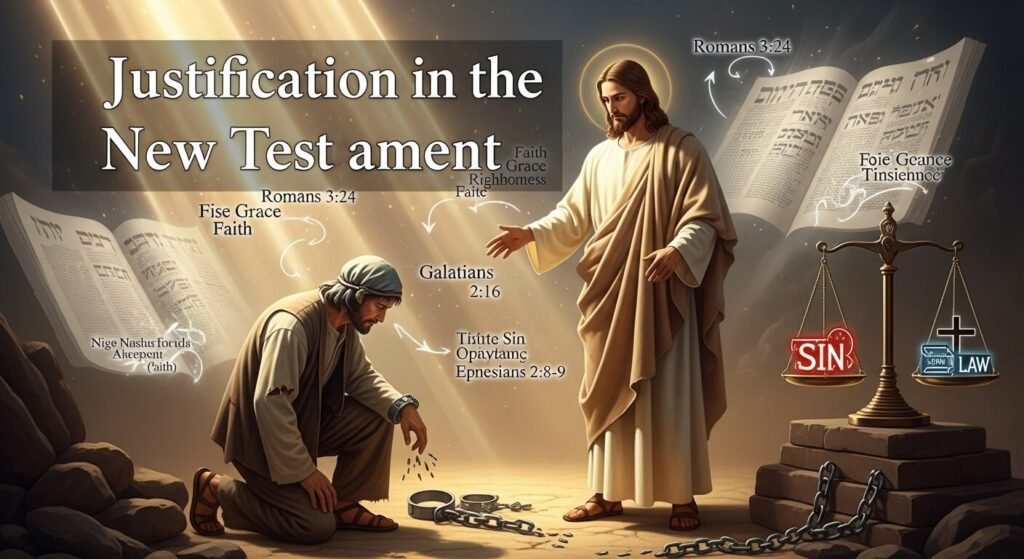
The Gospels rarely use the word “justification,” yet Jesus’s ministry is saturated with scenes of sinners being declared right with God, which is exactly what justification means.
The Word Doesn’t Appear — But the Concept Does: Scenes of Forgiveness and Acceptance
- The paralytic (Mark 2:5): Jesus declares, “Your sins are forgiven” — a pronouncement of status change, not a gradual process.
- Zacchaeus (Luke 19:9): “Today salvation has come to this house” — immediate and unconditional.
- The woman caught in adultery (John 8:11): “Neither do I condemn you” — an acquittal pronounced before any moral reformation.
- The tax collector’s prayer (Luke 18:14): Jesus explicitly says the tax collector “went home justified” (dedikaiomenos) — the clearest direct use of the dikaioo verb in any Gospel narrative.
The Parable of the Pharisee and the Tax Collector (Luke 18:9–14) — Jesus’s Clearest Justification Teaching
This parable predates Paul’s letters by decades and is the New Testament’s most direct enacted statement of justification.
The Pharisee presents his moral credentials; the tax collector has only one appeal: God’s mercy. Jesus renders a verdict: the tax collector, not the Pharisee, went home justified.
The parable establishes three principles that Paul will later systematise: justification is a verdict declared by God, not earned by performance; it is received through acknowledged need, not presented credentials; and God’s pronouncement reverses human expectation entirely.
Justification in Paul’s Letters — The Doctrinal Heart of the New Testament
Paul devotes more sustained argument to justification than any other New Testament author. For a deeper study of the Pauline framework, see Paul’s doctrine of righteousness in Romans.
Romans 3–5: The Locus Classicus — What Paul Actually Argues
Paul’s argument in Romans 3:21–5:1 follows a sequential logic:
- The universal problem (3:21–23): All humanity — Jew and Gentile — has sinned and falls short of God’s standard. No one achieves righteous standing by moral performance.
- The divine solution (3:24–26): God justifies sinners “freely by his grace through the redemption that is in Christ Jesus.” The ground is Christ’s atoning work, not human effort.
- The instrument of reception (3:27–28): Faith, not “works of the law,” is how a person receives justified status.
- The Abraham precedent (4:1–8): Genesis 15:6 — written before the Mosaic law and before Abraham’s circumcision, proves God counted Abraham righteous based on belief alone.
- The result (5:1): “Since we have been justified by faith, we have peace with God through our Lord Jesus Christ.”
Galatians and the Crisis That Forced Paul’s Sharpest Justification Language
Galatians is Paul’s most urgent letter because Jewish-Christian teachers had insisted that Gentile believers adopt circumcision to be fully included in God’s covenant people.
Paul’s response is unambiguous: to add any condition to faith as the basis of justification is to preach “a different gospel” (Galatians 1:6–9). Galatians 2:16 states the principle three times in a single verse.
Abraham as Paul’s Test Case — What Genesis 15:6 Proves
- Timing argument: God credited Abraham as righteous (Genesis 15:6) before his circumcision (Genesis 17) — proving circumcision did not cause the justified status.
- Promise argument: Abraham received the promise through faith, not law-keeping — the Mosaic law came 430 years later (Galatians 3:17).
- Universal argument: Because Abraham was justified as an uncircumcised person, his justification becomes the pattern for all nations, not only ethnic Israel (Romans 4:16–17).
Key Justification Verses in Paul — Quick Reference Table
| Verse | Core Claim | Key Greek Term |
|---|---|---|
| Romans 3:28 | Justified by faith apart from works of the law | dikaiouthai |
| Romans 4:5 | God justifies the ungodly who believe | ton dikaiōnta |
| Romans 5:1 | Peace with God through justification by faith | dikaiōthentes |
| Galatians 2:16 | No one is justified by works of the law | dikaioutai |
| Philippians 3:9 | Righteousness through faith in Christ, not law | dikaiosynē |
| 2 Corinthians 5:21 | Believers become the righteousness of God in Christ | dikaiosynē |
Does James Contradict Paul? Justification by Works in James 2
The simple answer to this is no, but the reconciliation requires precision, not just reassurance.
James 2:24 — “Justified by Works, Not Faith Alone”: What James Actually Means
Many misinterpret James 2:14-24 to mean salvation must be earned through good works. But here’s the truth:
- Abraham was justified by faith in Genesis 15.
- His offering of Isaac in Genesis 22 was not what made him righteous, but the fruit of his spiritual growth.
James wasn’t addressing righteousness before God. Paul already established that. Instead, James focused on spiritual maturity. Mature faith naturally produces love-driven actions, like caring for the needy.
So when James says “faith without works is dead”, he’s not questioning salvation. He’s showing that real faith grows and bears fruit.
- Works are the fruits of righteousness, not the requirements for it.
Why Paul and James Are Not Contradicting Each Other — The Reconciliation
- They address different opponents. Paul argues against those who add law-keeping as the basis of justification. James argues against those who claim faith while producing no moral consequence — what he calls “dead faith.”
- They use “justify” in different rhetorical contexts. Paul uses dikaioo to describe God’s initial verdict. James uses it to describe the public vindication — the visible proof — that a person’s faith is genuine. Both cite Abraham, but at different moments: Genesis 15:6 (Paul) versus Genesis 22 (James) — decades apart.
- They mean different things by “faith.” Paul’s faith is a whole-person trust in Christ. James’s target is theological fact-acknowledgment with no personal surrender: “Even the demons believe and shudder” (2:19).
What “Dead Faith” Means and Why It Cannot Justify
Dead faith is not weak faith; it is fraudulent faith.
- Claims to “have faith” verbally while producing no response to others in need (James 2:15–16).
- Can articulate orthodox theology — “God is one” (2:19) — without that theology shaping any behaviour.
- Is to genuine faith what a corpse is to a living body — same form, no animating principle (2:26).
Justification in Hebrews — The Priestly Dimension Often Overlooked
Most readers go from Paul straight to James and miss Hebrews entirely. This is a significant gap: Hebrews provides the ritual architecture that explains how justification is possible.
The High Priest and the Atonement — How Hebrews Grounds Justification in Christ’s Priestly Work
Hebrews 7–10 argues that the Levitical priestly system, with its repeated animal sacrifices, could never finally remove sin or give the worshiper a clear conscience before God (10:1–4).
Christ, as the eternal High Priest after the order of Melchizedek, offers a single, unrepeatable sacrifice that achieves what the old system could not: permanent atonement and a settled status before God.
Hebrews 10:14 states that “by a single offering he has perfected for all time those who are being sanctified.”
This “perfecting” is the priestly equivalent of Paul’s justification of a complete, objective standing before God grounded in Christ’s work alone.
Hebrews 11 — The Faith Hall of Fame as a Justification Argument
- Abel (11:4): Described as “commended as righteous” (emartyrēthē einai dikaios) — the same Greek root as Paul’s justification vocabulary — based on faith.
- Abraham (11:8–19): Obeyed, waited, and offered; all described as acts of faith, directly connecting Hebrews to Paul’s argument in Romans 4. See Justification in the Old Testament.
- Rahab (11:31): A Gentile included among the faithful because faith expressed itself in action, a bridge to James’s argument about living faith.
Imputed vs. Infused Righteousness — The Protestant–Catholic Divide
The most significant denominational fault line over justification is not whether faith matters, all traditions affirm that it does, but what God actually does when he justifies a sinner.
What Imputed Righteousness Means and Its Scriptural Basis
Imputed righteousness is the Protestant teaching that when God justifies a sinner, he credits and legally transfers Christ’s own perfect righteousness to the believer’s account.
The believer is not made intrinsically righteous; Christ’s righteousness is counted as theirs.
The primary texts are Romans 4:3–6 (Abraham’s faith “credited as righteousness”), 2 Corinthians 5:21, and Philippians 3:9.
The Catholic View — Justification as Transformation, Not Just Declaration
The Council of Trent (1547) defined justification as “not only the remission of sins but also the sanctification and renewal of the inward man through the voluntary reception of grace.”
God does not merely pronounce the sinner righteous; he makes them righteous by infusing righteousness through sacramental grace.
This means the Catholic term “justification” encompasses both what Protestants call justification and what they call sanctification.
The disagreement is not over whether grace is necessary, but over whether justification is an instantaneous forensic verdict or an ongoing transformative process.
Protestant, Catholic, and Eastern Orthodox Views Side by Side
| Tradition | Mechanism | Timing | Role of Works | Key Texts |
|---|---|---|---|---|
| Reformed / Lutheran | Imputation — Christ’s righteousness credited | Instantaneous at faith | Evidence of genuine faith; not its basis | Romans 3:28; Ephesians 2:8–9 |
| Roman Catholic | Infusion — grace poured in via sacraments | Begins at baptism; ongoing | Meritorious cooperation with grace | James 2:24; Council of Trent |
| Eastern Orthodox | Theosis — participation in divine nature | Ongoing union with Christ | Integral expression of love and faith | 2 Peter 1:4; John 17:21–23 |
For the full Protestant and Catholic case, see imputed and infused righteousness in Protestant and Catholic theology.
The New Perspective on Paul — A Modern Challenge to Traditional Justification Doctrine
Let’s see below the popular scholarly debate.
What the New Perspective Says and Why It Changed the Debate
The New Perspective on Paul (NPP), associated with E.P. Sanders, James D.G. Dunn, and N.T. Wright makes three core claims:
- First-century Judaism was not a works-righteousness religion. Sanders argued that Judaism operated on “covenantal nomism” — membership in God’s covenant came by grace, and law-keeping was a response to that covenant, not a means of earning entrance into it.
- “Works of the law” means Jewish ethnic markers, not moral effort generally. On the NPP reading, Paul’s target is the boundary-marking practices (circumcision, dietary laws, Sabbath-keeping) that separated Jews from Gentiles.
- Justification is primarily a covenant membership declaration. N.T. Wright argues justification answers “Who belongs to God’s people?” as much as “How does an individual get right with God?”
Strengths, Weaknesses, and Where the Scholarly Consensus Now Stands
| NPP Claim | Strength | Critique |
|---|---|---|
| Judaism was covenantal, not purely merit-based | Corrects a real caricature of Second Temple Judaism | Does not account for all merit-language found in Jewish texts of the period |
| “Works of law” = ethnic boundary markers | Explains the Jew–Gentile tension in Galatians 2–3 contextually | Romans 2:14–15 applies “law” to Gentiles with no ethnic function — hard to explain on NPP terms alone |
| Justification = covenant membership | Captures the communal dimension Paul does address | Romans 4:5 (“God justifies the ungodly“) concerns individual sinners, not group belonging |
The current consensus is a modified synthesis: the NPP enriches the social and covenantal background of Paul’s language without displacing the Reformation emphasis on individual standing before a holy God.
Justification and Assurance — Can You Know You Are Justified?
Whether a justified person can be certain of their status is one of the most practically significant questions the New Testament addresses. Below are scriptures that assure you of your standing with God.
What the New Testament Says About the Permanence of Justification
The New Testament grounds assurance in the objective work of Christ, not in the believer’s subjective moral performance:
- Romans 5:1: “Since we have been justified by faith, we have peace with God” — past tense, settled reality.
- Romans 8:1: “There is therefore now no condemnation for those who are in Christ Jesus.”
- Romans 8:33–34: “Who shall bring any charge against God’s elect? It is God who justifies.”
- John 5:24: “He does not come into judgment, but has passed from death to life.”
- Hebrews 10:14: “By a single offering he has perfected for all time those who are being sanctified.”
How Different Traditions Approach Assurance of Justification
| Tradition | View on Permanence | Key Texts |
|---|---|---|
| Reformed (Calvinist) | Irrevocable — the elect cannot ultimately fall away | Romans 8:28–39; John 10:28–29 |
| Lutheran | Permanent, but can be forfeited through wilful rejection of faith | Hebrews 6:4–6 |
| Wesleyan / Arminian | Can be forfeited through sustained, wilful apostasy | Galatians 5:4 |
| Roman Catholic | Lost through mortal sin; restored through penance | Council of Trent, Session 6 |
Frequently Asked Questions About Justification in the New Testament
What is the simplest definition of justification in the New Testament?
Justification is God’s act of declaring a sinner righteous — not guilty — on the basis of Christ’s atoning work, received through faith.
It is a verdict about legal standing before God, not a description of current moral condition. The Greek verb dikaioo means to pronounce righteous, as a judge pronounces a verdict.
Does Paul ever use the phrase “faith alone” (sola fide)?
Paul never uses the exact phrase “faith alone,” which appears only once in the New Testament, in James 2:24, where it is denied.
Paul makes the equivalent case using “faith apart from works of the law” (Romans 3:28) and “not your own doing” (Ephesians 2:8–9).
Luther’s addition of “alone” to his German translation captured Paul’s intent accurately, even though the word is not in the Greek text.
Is justification a one-time event or an ongoing process?
Paul’s usage is clearly past-tense and decisive: “we have been justified” (dikaiōthentes, Romans 5:1) — an aorist participle indicating a completed action.
Therefore, based on God’s Word, which is supreme over men’s traditions, Justification is a one-time event, not an ongoing process.
Catholic and Orthodox traditions extend the word to include the ongoing process of transformation.
Whether that terminological difference reflects a substantive theological one is the central ecumenical question.
Why does the word “justification” rarely appear in the Gospels
The noun dikaiosis appears only twice in the entire New Testament (Romans 4:25; 5:18) and not at all in the Gospels.
The concept is present most explicitly in Luke 18:14, where Jesus says the tax collector “went home justified.”
Paul developed the doctrinal vocabulary; Jesus enacted the reality that the vocabulary would later describe.
What role does baptism play in justification according to the New Testament?
The New Testament seems to connect baptism closely to justification (Romans 6:3–4; Titus 3:5–7), but Paul consistently attributes justification directly to faith, never directly to baptism.
Most Protestant traditions interpret the baptism texts as referring to the faith that baptism publicly expresses; Catholic and Orthodox traditions understand baptism as the sacramental moment of initial justification.
Read our bible explanation of the following for more study on baptism: Is it a sin to get baptised twice?, and is baptism necessary for Salvation?
How does the resurrection of Jesus relate to justification (Romans 4:25)?
Romans 4:25 states Jesus “was delivered over to death for our sins and was raised to life for our justification.”
The resurrection is not only proof of Christ’s identity, but it is the Father’s public vindication that the atoning death was accepted.
The risen Christ, enthroned at God’s right hand (Romans 8:34), is the living ground of the believer’s justified standing before God.
Are there good books on justification for a beginner?
Three accessible starting points are The Cross of Christ by John Stott, What Is the Gospel? by Greg Gilbert, and, for the denominational debate, N.T. Wright’s Justification, paired with John Piper’s The Future of Justification, which presents the New Perspective and traditional Reformed cases.
In addition, I also recommend New Creation Realities by W.E. Kenyon and Destined to Reign or the Power of Right Believing by Joseph Prince.
Does the Eastern Orthodox Church believe in justification by faith?
Eastern Orthodoxy affirms that salvation is entirely God’s gift received through faith, but uses the language of theosis, participation in the divine nature, more than justification.
Orthodox theology views the Western forensic frame as a partial account of a larger reality: union with Christ and transformation into his likeness.
The disagreement is partly terminological and partly substantive. To know more, read our Bible study guide on Orthodoxy’s view on how God imputes righteousness.

My passion lies in reaching out to young adults in communities and schools, witnessing the transformative power of faith in their lives.
This blog extends my ministry, sharing insights, encouraging believers, and exploring Christ's teachings in daily life.
Welcome, Brother James.
- Identity in Christ vs. Self-Esteem: Why They’re Not the Same Thing - September 13, 2026
- 40 Identity in Christ Bible Verses (Organized by Topic) - September 13, 2026
- What Does It Mean to Have Your Identity in Christ? - September 13, 2026