Have you ever picked up your Bible and wondered if you’re really getting anything out of it?
Maybe you read a few verses, feel confused by the context, and close it feeling more discouraged than encouraged.
Or perhaps you struggle with seeing the Bible as anything more than an ancient collection of stories that seem disconnected from your modern life. You’re not alone in these struggles.
Many believers wrestle with understanding God’s Word and applying it to their daily lives. They know the Bible is important, but they don’t fully grasp why or how it should transform them.
Some approach Scripture with religious duty rather than genuine expectation. Others read it looking for rules to follow instead of discovering the riches Christ has provided through His finished work.
But what if I told you that when you open the Bible, you’re not just reading ancient text, the word of God is christ speaking to you in the present moment?
According to W.E. Kenyon, we should approach God’s Word with the same reverence as if Jesus Himself were sitting with us and speaking directly to us. This changes everything about how we read Scripture.
In this sermon on the Word of God, we’ll explore how to properly understand Scripture, discover the transforming power contained within it, learn the purpose of preaching God’s Word, and see how the Bible functions as the foundation for victorious Christian living.
Join us prayerfully, believing you will receive wisdom from God, the Father of Lights, with whom there is no variation or shifting shadows. Amen!
Understanding the Word of God Through Christ
To truly understand the Word of God, we must recognize that the entire Bible is a book about one Person—Jesus Christ—and His plan of salvation for mankind.
This is not just a theological concept; it’s the key that unlocks all of Scripture.
When Jesus rose from the dead and joined the disciples on the road to Emmaus, Luke 24:27 tells us, “And beginning at Moses and all the Prophets, he expounded unto them in all the scriptures the things concerning himself.”
Notice that Jesus started with Moses (the first five books of the Bible) and went through all the prophets, showing how every part of Scripture pointed to Him.
The Old Testament is Christ concealed, while the New Testament is Christ revealed. When you read Genesis, the Psalms, Isaiah, Jonah, or Zechariah, they should all lead you to one destination: Jesus Christ and His finished work.
All Scripture must be interpreted in light of the death, burial, and resurrection of Jesus. This is not optional, it’s essential for proper biblical understanding.
When our hearts are enlightened and full of God’s Word through this Christ-centered lens, Psalm 18:29 promises we can “leap over walls and run through troops” of circumstances.
The moment we locate these truths about Christ in God’s Word, we gain supernatural ability to overcome obstacles that once seemed impossible.
Consider this practical example: If I wrote you a series of letters, you wouldn’t just read the first chapter and stop there.
You would read all my letters in their entirety to fully comprehend the subject matter and grasp the main point I’m discussing.
The same principle applies to Scripture—context is crucial, and the Bible must interpret the Bible.
How the Apostles Preached the Word
The book of Acts provides a perfect blueprint for understanding and preaching God’s Word.
The apostles consistently followed Jesus’ pattern from Luke 24:27, starting with the Old Testament and showing how it pointed to Christ.
In Acts 2:16, Peter explained the infilling of the Holy Spirit by referencing the prophet Joel. He didn’t just share his opinion—he showed how Old Testament prophecy was being fulfilled before their eyes.
Acts 3:18-26 records Peter declaring, “But these things, which God before had shewed by the mouth of all his prophets, that Christ would suffer, he had so fulfilled.”
Peter connected the suffering and resurrection of Christ to centuries-old prophecies.
Even Stephen, in Acts 7:2-60, started from Abraham and expounded God’s Word throughout history, finally arriving at the destination: Christ the Promised Savior.
This wasn’t random—it was intentional, Spirit-led interpretation that always pointed to Jesus.
This pattern teaches us that Scripture is of no private interpretation (2 Peter 1:20).
To understand the apostles’ message, we must sit where they sat and hear what they heard. We must see Christ as the central figure of all biblical revelation, from Genesis to Revelation.
The Transforming Power of the Word of God
If you believe that we are what we eat physically, then you must also agree that we become what we read and hear spiritually.
This is why Jesus said in Mark 4:23-24, “Take heed what you hear.” What we hear often transforms our lives, circumstances, character, attitude, and even our nations.
A powerful example of this transforming power is found in Acts 19. Paul encountered disciples who had believed in John’s baptism but had not yet received the full Gospel of grace.
These were sincere people, but they were living under an incomplete revelation. What did Paul do? He taught them the complete Gospel.
Acts 19:8 records that Paul “went into the synagogue, and spoke boldly for the space of three months, disputing and persuading the things concerning the Kingdom of God.”
But he didn’t stop there. Acts 19:10 tells us Paul continued teaching for two full years. Why such persistence? Because the Gospel is the power that transforms people and nations.
The results were remarkable. The Gospel wrought miracles, signs, and wonders. Evil spirits were cast out. And Acts 19:20 declares, “So mightily grew the Word of God and prevailed.”
What was this “Word of God”? Simply the message of the death, burial, and resurrection of Christ—the Gospel that brings us out of darkness into light, gives us eternal life, and establishes peace with God.
As we continually look into the Mirror of God’s Word, 2 Corinthians 3:18 promises we are being transformed into Christ’s image from glory to glory.
This isn’t transformation through human effort, it’s transformation through beholding who we are in Christ and what He accomplished for us. The Word shows us our true identity, and as we see it, we become it.
The Purpose of Preaching the Word of God
Why is preaching God’s Word so essential? The primary purpose is to ignite faith in the hearts of both the unsaved and believers.
Here’s the beautiful truth: the Gospel supplies faith to you—it doesn’t demand faith from you.
Romans 10:14-17 lays out the divine progression: “How then shall they call on Him in whom they have not believed? And how shall they believe in Him of whom they have not heard?
And how shall they hear without a preacher?… So then faith comes by hearing, and hearing by the word of God.”
Notice that faith isn’t something you manufacture through willpower. Faith comes—it arrives—when you hear the Word of God.
The Gospel carries its own faith-producing power. This is why preaching is not just helpful; it’s essential.
When you examine Matthew 4:23, Matthew 9:35, and Luke 9:6, you discover that healing of all manner of sicknesses and diseases accompanied the Gospel.
Where you find the preaching of God’s Word, healing also manifests. Why? Because the Word contains the riches of his grace—all the provision Christ secured through His finished work.
Romans 16:25 tells us that what establishes believers in faith is the preaching of the Gospel, the message of God becoming man and redeeming humanity once and for all.
This is so critical that Paul warned in Galatians 1:8-9 that even if an angel preached any other gospel, let him be accursed.
1 Corinthians 1:18 declares, “The preaching of the cross… is the power of God.” And 1 Corinthians 15:14 emphasizes, “If Christ be not risen, then is our preaching vain, and your faith is also vain.”
The resurrection of Christ validates everything we preach. Because Christ is risen, the Gospel is fruitful, and our faith is effective.
The Living and Powerful Nature of God’s Word
Unlike any other book ever written, Scripture possesses a unique quality that sets it apart: it’s alive. Hebrews 4:12 declares, “The word of God is living and powerful, and sharper than any two-edged sword, piercing even to the division of soul and spirit, and of joints and marrow, and is a discerner of the thoughts and intents of the heart.”
Let’s break down what this means practically:
Living – God’s Word isn’t dead letters on a page. It possesses divine life and continues to speak to each generation with fresh relevance.
The same verses that encouraged believers 2,000 years ago can speak directly to your situation today with the same power.
Powerful (Active) – The Greek word “energes” means the Word is energetic and effective, accomplishing God’s purposes wherever it’s proclaimed.
Romans 1:16 calls the Gospel “the power of God unto salvation.” It doesn’t just contain information; it releases transformation.
Sharp – God’s Word penetrates deeply into human hearts and minds, cutting through pretense and revealing truth.
It gets past your defenses, your excuses, and your rationalizations to expose what’s really happening in your heart.
Discerning – Scripture has the supernatural ability to judge thoughts, motives, and intentions. It exposes what lies beneath the surface of human behavior, revealing both good and bad with perfect accuracy.
This living quality means Scripture isn’t merely a historical document. It remains dynamically relevant, speaking to contemporary issues and personal situations with divine authority and transformative power.
When you read God’s Word, you’re not studying ancient history, you’re encountering the living Christ who speaks into your present reality.
Practical Benefits of the Word of God

The Word of God offers numerous tangible benefits that affect every area of a believer’s life:
Spiritual Cleansing – Jesus prayed in John 17:17, “Sanctify them by Your truth. Your word is truth.” The Word washes and cleanses us, not through condemnation but through revelation of who we are in Christ.
Guidance and Direction – Psalm 119:105 promises, “Your word is a lamp to my feet and a light to my path.” When you’re unsure which direction to take, Scripture illuminates the way forward.
Victory Over Sin – Psalm 119:11 says, “Your word I have hidden in my heart, that I might not sin against You.” The Word provides power to overcome temptation and live victoriously.
Faith Building – Romans 10:17 confirms, “Faith comes by hearing, and hearing by the word of God.” The more you expose yourself to Scripture, the stronger your faith grows—not through striving but through hearing.
Understanding Your Authority – Luke 10:19 reveals the authority believers have over the enemy’s works. The Word shows you what you possess in Christ, enabling you to <u>walk in your new identity</u> with confidence.
Knowledge of Your Righteousness – 2 Corinthians 5:21 declares you are “the righteousness of God in Him.” The Word reveals that your right standing with the Father is secured and eternal, not based on performance.
Renewal of Mind – The Word renews your mind to the new identity you now have in Christ and dispels every doubt the devil throws at you.
Romans 12:2 promises transformation through the renewing of your mind, and God’s Word is the primary tool for this renewal.
Four Essential Functions of Scripture
Based on 2 Timothy 3:16-17, Scripture accomplishes four vital functions in a believer’s life:
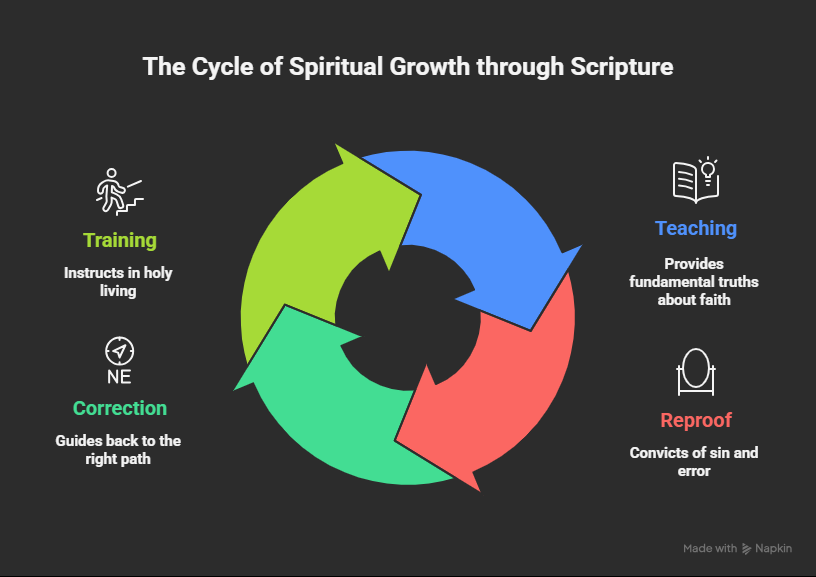
Teaching (Doctrine) – The Word provides fundamental truths about God, salvation, and Christian living.
It establishes the theological foundation for faith, answering questions like “Who is God?”, “Who am I in Christ?”, and “How does salvation work?”
Reproof – Scripture convicts us of sin and error, serving as a mirror that reveals our spiritual condition.
But remember, under the New Covenant, this conviction isn’t to condemn you but to reveal areas where you’re not walking in the fullness Christ provided.
Correction – The Word guides us back to the right path when we’ve strayed. It offers restoration and realignment with God’s will, always pointing us back to the truth of who we are in Christ.
Training in Righteousness – Scripture instructs believers in holy living, providing practical guidance for godly conduct and spiritual maturity. It shows us how to walk out our identity in Christ in everyday situations.
These four functions work together to demonstrate that the Word of God is not optional for the believer but essential for spiritual life, growth, and effectiveness in Christian living.
Frequently Asked Questions About the Word of God
The Word of God serves as the foundation of Christian faith and practice. Scripture emphasizes that believers are “born again, not of corruptible seed but incorruptible, through the word of God which lives and abides forever” (1 Peter 1:23).
Jesus declared in Matthew 4:4, “Man shall not live by bread alone, but by every word that proceeds from the mouth of God.”
Just as food sustains your physical body, God’s Word nourishes your spirit.
The central message is that Scripture reveals God’s character, His will, and His plan of salvation through Jesus Christ.
The Word testifies of Christ, as Jesus told the Pharisees in John 5:39: “You search the Scriptures, for in them you think you have eternal life; and these are they which testify of Me.”
Ultimately, the Word proclaims the gospel message of redemption, forgiveness, and eternal life available through faith in Jesus Christ.
Approach Scripture with the understanding that you’re hearing Christ speak to you in the present moment.
Remember that all Scripture points to Jesus and His finished work. Read with expectation, believing the Holy Spirit will illuminate truth to you.
Context is crucial—let the Bible interpret the Bible rather than imposing your own interpretations.
Absolutely. Acts 19:20 demonstrates that the Word “mightily grew and prevailed,” transforming an entire city.
The Gospel contains inherent power to change hearts, minds, circumstances, and even nations.
It’s not about your ability to change yourself, it’s about the living, active power of God’s Word working in you.
Conclusion: Living by the Living Word
This sermon on the Word of God has revealed powerful truths: Scripture is not just an ancient book but the living voice of Christ speaking to you today.
Every verse points to Jesus and the salvation He secured through His death, burial, and resurrection. The Word transforms us as we behold our true identity in Christ, supplies faith rather than demanding it, and provides everything we need for victorious Christian living.
The Gospel is not religious obligation—it’s the good news that Christ has finished the work. Your right standing with God is secured.
Your identity is established. Your future is guaranteed. As you continue reading and meditating on God’s Word, you’re not trying to earn God’s favor; you’re discovering the riches you already possess in Christ.
May the wisdom in this sermon inspire you to live a more purposeful life in the service of our Lord and Savior Jesus Christ.
Approach His Word with expectation, knowing that as you do, the same Spirit who inspired it will illuminate it to your heart, transforming you from glory to glory.
If this teaching has touched your heart, subscribe to our newsletter to receive more encouraging content about living in the fullness of what Christ has provided.
Don’t miss our other articles exploring the finished work of Christ and the riches believers possess in Him.
To the glory of the Almighty, forever and ever. Amen.

My passion lies in reaching out to young adults in communities and schools, witnessing the transformative power of faith in their lives.
This blog extends my ministry, sharing insights, encouraging believers, and exploring Christ's teachings in daily life.
Welcome, Brother James.
- What Does the Bible Say About Culture and Traditions? - March 16, 2026
- Scriptural Prayers for Pastors and Leaders - March 16, 2026
- 100 Prosperity Scriptures - March 16, 2026