
The cross gets most of the attention when we talk about salvation, and rightly so, Christ’s death paid sin’s penalty. But the resurrection is equally essential for justification.
Without the resurrection, Christ’s death would be meaningless, and your justification would be unconfirmed.
Paul says in 1 Corinthians 15:17, “if Christ has not been raised, your faith is futile, and you are still in your sins.” That’s a strong statement.
The resurrection isn’t an optional decoration on the gospel; it’s the divine confirmation that Christ’s death actually worked.
It proves God accepted the sacrifice, validates justification’s legal basis, and guarantees believers’ security.
Christ’s death satisfied justice; His resurrection declared that satisfaction was accepted. Together, they make justification both possible and certain.
Understanding how the resurrection functions in justification strengthens your assurance and clarifies why Christianity stands or falls on an empty tomb.
Why the Resurrection Matters for Justification
Many Christians understand Christ’s death is essential, but miss why His resurrection is equally crucial. The resurrection isn’t an afterthought; it’s God’s validation that justification works.
Without it, justification remains unconfirmed and uncertain.
The Danger of Separating Cross and Resurrection
Some focus exclusively on the cross while treating resurrection as secondary. But Scripture never separates them.
Romans 4:25 says Jesus “was delivered up for our trespasses and raised for our justification.” Notice: death for trespasses, resurrection for justification. Both are essential.
Separating them leaves the justification incomplete. The cross without resurrection is an unconfirmed sacrifice. Would God have accepted Christ’s death if Jesus stayed dead?
The resurrection answers that question definitively. You can’t have justification with only half the gospel; death provides the basis; resurrection provides the proof.
Justification Requires Confirmation
Legal verdicts need validation. In God’s courtroom, the resurrection is that validation. Christ’s death proposed a solution to sin; His resurrection confirmed that God accepted that solution.
Without confirmation, you’re left wondering if the sacrifice was sufficient. Did it work? Was it enough? The resurrection removes all doubt.
It’s God’s public declaration that justice has been satisfied and justification is legitimate. Acts 2:24 says, “God raised him, loosing the pangs of death, because he couldn’t be held by it.”
Death couldn’t hold Him because His sacrifice was complete.
Why a Risen Christ Is Essential
A dead savior can’t save anyone. If Christ remained in the tomb, He’d be just another failed religious leader. But 1 Corinthians 15:17 warns that without resurrection, “you are still in your sins.”
A dead Christ means an unaccepted sacrifice, unconfirmed justification, and no hope.
But a risen Christ means the sacrifice worked, God accepted it, and justification stands. The resurrection makes Christ a living Savior, not a dead martyr.
Your justification depends on a living Christ who conquered death and validates God’s verdict about you.
Christ’s Death as the Basis, Resurrection as the Confirmation
Understanding the relationship between death and resurrection clarifies how justification works.
They’re distinct but inseparable. Death justifies its basis; resurrection provides its confirmation. Both are essential and work together.
Death Satisfies Justice
Christ’s death satisfied God’s justice by bearing sin’s penalty. Romans 3:25 describes Christ as a propitiation, a sacrifice that satisfies God’s wrath.
Justice demanded punishment for sin; Christ’s death provided it. He bore the full penalty, exhausted God’s wrath, and paid sin’s debt completely.
The cross is where justice was served. Without Christ’s death, there’s no basis for justification. His death is the legal ground for the payment that makes the justification just.
Justice is satisfied at the cross, making mercy possible.
Resurrection Declares Acceptance
The resurrection is God’s declaration that He accepted Christ’s sacrifice as sufficient. If the Father hadn’t accepted Christ’s work, Jesus would have stayed dead.
But Acts 2:32 declares, “This Jesus God raised.” The resurrection is the Father’s “yes” to the Son’s sacrifice.
It’s divine approval, validation that the payment was sufficient. Romans 1:4 says Jesus was “declared to be the Son of God in power… by his resurrection from the dead.”
The resurrection declares what the cross accomplished: justice satisfied, debt paid, acceptance granted.
How Both Work Together
Death and resurrection aren’t competing explanations—they’re complementary parts of one salvation. The cross provides the legal basis; the resurrection provides the legal proof.
Romans 4:25 connects both: “delivered up for our trespasses” (death’s work) and raised for our justification” (resurrection’s work).
You need both. Death without resurrection is unconfirmed; resurrection without death has nothing to confirm.
Together, they establish and validate justification. Christ died to pay your debt; He rose to prove payment was accepted. Both are indispensable for justification.
The Resurrection as God’s Vindication of Christ
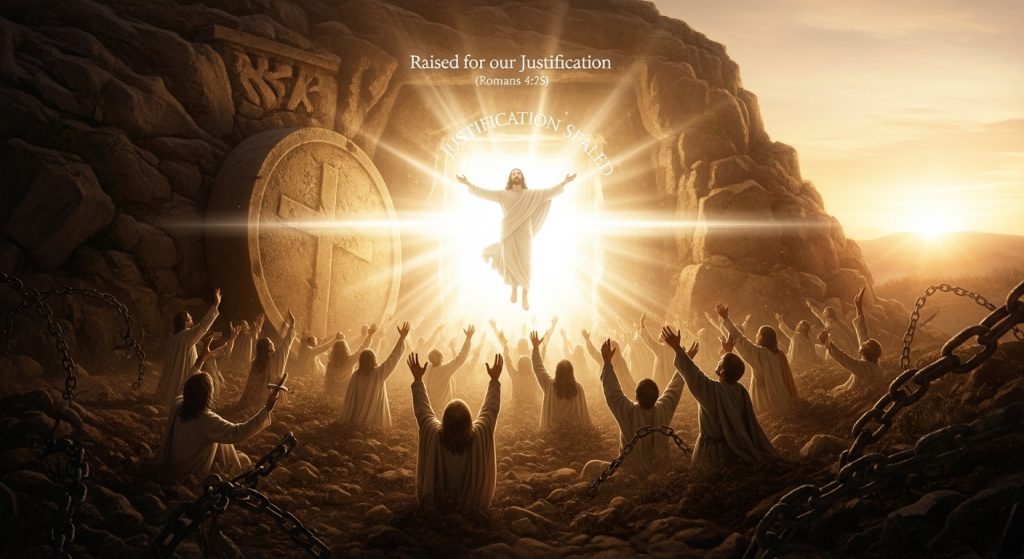
The resurrection vindicated Christ publicly. It proved everything He claimed and accomplished. This vindication matters for justification because it validates the One who secures your righteousness.
Christ Publicly Declared Righteous
Jesus lived perfectly righteous, yet was condemned as a criminal and executed. The resurrection vindicated Him—it declared publicly that He was righteous all along.
1 Timothy 3:16 says Christ was “vindicated by the Spirit.” His righteousness was proven through resurrection. The same crowd that shouted “Crucify him!” would soon hear that God raised Him from the dead.
The resurrection overturns the unjust human verdict with God’s righteous verdict. Christ stands vindicated before all creation.
Resurrection as Divine Approval
The resurrection is God’s stamp of approval on Christ’s entire ministry and sacrifice. It’s the Father saying, “This is my beloved Son, and His work is complete.”
Acts 2:36 declares, “God has made him both Lord and Christ, this Jesus whom you crucified.” The resurrection elevated Christ publicly, demonstrating divine approval of His person and work.
This matters for justification: if God approved Christ and His sacrifice, then those united to Christ by faith share that approval.
Why the Grave Could Not Hold Him
Acts 2:24 explains that death couldn’t hold Christ “because it was not possible.” Why not? Because He owed death nothing—He had no sin of His own.
He died voluntarily for others’ sins, but death had no claim on Him personally. Having paid sin’s full penalty, death lost its power over Him.
Romans 6:9 says, “death no longer has dominion over him.” The resurrection was inevitable because Christ completed His work perfectly.
The grave couldn’t hold Him because justice was satisfied. His resurrection was a necessity, not a miracle.
Justification and the Empty Tomb
The empty tomb isn’t just a historical curiosity; it’s legal proof that justification works. Understanding the tomb’s significance for justification strengthens assurance and grounds faith in objective reality.
Resurrection as Legal Proof
In God’s courtroom, the resurrection functions as evidence that justification is valid. If Christ’s sacrifice had been insufficient, He’d have remained dead.
But the empty tomb proves God accepted the sacrifice as sufficient payment. It’s like a receipt showing “Paid in Full.”
Romans 4:25 says Jesus “was raised for our justification”—the resurrection serves justification’s interests.
It’s the legal proof that what Christ died to accomplish actually worked. No resurrection means no proof; resurrection means validated justification.
“Raised for Our Justification” Explained
Romans 4:25’s phrase “raised for our justification” is crucial. The Greek “dia” (for) indicates purpose—the resurrection happened for the sake of our justification.
Christ’s resurrection wasn’t just personal vindication—it secured and confirmed justification for believers. His resurrection validates that believers are justified. He was raised to declare justification complete, debt paid, penalty satisfied.
The resurrection serves your justification by proving it’s legitimate. When Christ walked out of the tomb, your justification was confirmed.
No Justification Without Resurrection
Paul states this plainly: “if Christ has not been raised… you are still in your sins” (1 Corinthians 15:17). Without resurrection, there’s no justification—only unconfirmed sacrifice and uncertain forgiveness.
The resurrection is non-negotiable for justification. It’s not that death is insufficient; it’s that death needs resurrection to validate it.
The resurrection proves the sacrifice worked. Without it, you have no assurance, no confirmation, no certainty. Christ must rise for justification to be real. The empty tomb is essential, not optional.
The Resurrection and the Removal of Condemnation
Christ’s death bore condemnation; His resurrection proves that condemnation is gone.
Understanding this connection shows why believers can be certain they face no condemnation—not now, not ever.
Condemnation Exhausted at the Cross
Romans 8:3 says God “condemned sin in the flesh” of Christ. At the cross, condemnation was poured out fully on Jesus.
He experienced God’s wrath completely. The condemnation sinners deserved was exhausted on Christ. He drained the cup of wrath to the dregs. Nothing remained.
The cross is where condemnation died. Christ bore it all—past, present, and future condemnation for every believer. The penalty was fully executed on Him.
Resurrection Confirms No Remaining Penalty
The resurrection proves no condemnation remains because Christ is free from death’s penalty. If the penalty remained, Christ would still be dead. But He rose, demonstrating that condemnation is finished.
Romans 6:9 says, “death no longer has dominion over him.” Why? Because the penalty is paid and the condemnation is exhausted.
His resurrection proves no outstanding debt exists. If there were remaining condemnation, the grave would have held Him. The empty tomb declares: condemnation is gone.
Living Savior, No Ongoing Charge
Because Christ lives, no charge can stick to believers. Romans 8:34 asks, “Who is to condemn? Christ Jesus is the one who died—more than that, who was raised.”
The risen Christ proves that condemnation is impossible. He’s alive, interceding, maintaining your justification.
A living Savior means no ongoing accusation has validity. If Christ is alive, it’s because condemnation was fully dealt with. His living presence is your guarantee that no condemnation remains—now or ever.
The Risen Christ as the Ongoing Guarantee of Justification
Christ’s resurrection isn’t just a past event—it’s an ongoing reality that secures justification permanently. The living Christ actively maintains what His death secured. This provides unshakeable confidence.
Christ Lives as Justified Representative
Christ represents you before God as your justified head. He’s not just the one who secured justification—He’s the one who lives as the justified prototype.
His resurrection life guarantees yours. Romans 5:10 says, “If we were reconciled to God by the death of his Son, much more, now that we are reconciled, shall we be saved by his life.” His life maintains your justification.
He lives as proof that justified status is permanent. Your representative is alive and approved before God.
Intercession Grounded in Resurrection
Hebrews 7:25 says Christ “always lives to make intercession” for believers. His intercession depends on His resurrection—He must be alive to intercede.
Romans 8:34 grounds assurance in Christ’s resurrection and intercession: He “was raised” and now “is at the right hand of God… interceding for us.”
The living Christ prays for you continuously. His resurrection enables ongoing advocacy. Your justification is maintained by a living intercessor, not a dead hero.
This active intercession guarantees justification’s permanence.
Why Justification Is Secure
Justification is secure because Christ lives. If justification could be lost, Christ would need to die again.
But Hebrews 7:27 says He “has no need, like those high priests, to offer sacrifices daily… he did this once for all when he offered up himself.”
Once for all. Because Christ rose and lives forever, justification is permanent. His resurrection life guarantees your justified status can’t be revoked.
The living Christ ensures dead sins can’t undo living justification. Security rests on His resurrection life.
Resurrection, Faith, and Justification
Faith isn’t just belief in Christ’s death—it includes belief in His resurrection.
Understanding resurrection’s role in faith clarifies what saving faith actually involves, and why the resurrection is part of the gospel you must believe.
Faith in a Risen Christ
Saving faith trusts both Christ’s death and resurrection. Romans 10:9 says, “If you confess with your mouth that Jesus is Lord and believe in your heart that God raised him from the dead, you will be saved.”
Resurrection belief is part of saving faith. You’re not just trusting that Christ died—you’re trusting He rose. Faith in a dead Christ isn’t saving faith.
You must believe in the living, resurrected Christ who conquered death and lives forever.
Resurrection as Object of Faith
The resurrection isn’t just supporting evidence, it’s part of what you believe for salvation.
1 Corinthians 15:1-2 defines the gospel Paul preached: “Christ died for our sins… he was buried… he was raised on the third day.” All three are gospel content.
Faith receives the whole gospel: death, burial, resurrection. You can’t cherry-pick. Believing Christ died but not that He rose isn’t Christian faith—it’s incomplete trust that misses the gospel’s climax.
The resurrection is an essential object of saving faith.
Why Resurrection Belief Matters
Believing in Christ’s resurrection matters because it validates everything else you believe about Him. If He didn’t rise, His claims were false and His sacrifice ineffective.
But if He did rise, everything He said is true, and His work is complete. Romans 1:4 says He was “declared to be the Son of God in power… by his resurrection from the dead.”
The resurrection proves His identity and validates His work. Faith that includes resurrection belief is faith in a proven, living Savior, not a failed, dead prophet.
Justification and the Believer’s Future Resurrection
Christ’s resurrection guarantees believers’ future resurrection. Your justification now connects to your resurrection then. Understanding this link shows the justification’s ultimate goal and gives hope beyond this life.
Justified Now, Raised Later
Your present justification guarantees future resurrection. Romans 8:30 shows the progression: “those he justified he also glorified.” Justification leads to glorification—bodily resurrection.
If God justified you, He’ll raise you. 1 Corinthians 6:14 says, “God raised the Lord and will also raise us up by his power.” Christ’s resurrection is the pattern for yours.
You’re justified now; you’ll be raised later. The same power that justified you will resurrect you. Present justification secures future resurrection.
Resurrection as Future Vindication
Your future resurrection will publicly vindicate your justification. What’s legally true now (you’re justified) will be physically displayed then (you’re raised).
1 Thessalonians 4:16 says, “the dead in Christ will rise first.” Rising with Christ publicly demonstrates you belong to Him.
John 5:29 speaks of “the resurrection of life” for those who’ve done good—believers whose justification leads to resurrection.
Your resurrection will vindicate your faith publicly before all creation. It’s justification’s visible confirmation.
No Reversal at Final Judgment
Between justification and resurrection lies final judgment, but no reversal happens there. You’re justified now; judgment confirms it; resurrection displays it.
Romans 8:1 promises “no condemnation”—that includes final judgment. Believers aren’t waiting for judgment to determine justification—it’s already settled. Judgment evaluates works for rewards (2 Corinthians 5:10), not salvation status.
Your resurrection proves your justification stood. No reversal occurs. Justified now, vindicated then, raised eternally. The sequence is certain for all believers.
Resurrection vs Moral Example Theories
Some reduce resurrection to an inspirational symbol or a moral example. But this distorts its actual function in justification. The resurrection is a legal act in God’s courtroom, not just a motivational story.
Resurrection Not Merely Symbolic
Liberal theology often treats resurrection as symbolic—Christ’s “spirit” lives on in followers’ hearts. But Scripture presents bodily, physical resurrection.
Luke 24:39 records Jesus saying, “A spirit does not have flesh and bones as you see that I have.”
The tomb was literally empty; the body was literally raised. This matters for justification because symbolic resurrection can’t validate objective justification.
You need a real resurrection to prove real payment. Symbol doesn’t confirm legal reality; actual resurrection does.
Why Example-Only Views Fail
Some view resurrection as merely exemplifying victory over adversity. But this misses resurrection’s legal function.
The resurrection isn’t primarily about inspiring you—it’s about validating Christ’s sacrifice and confirming your justification.
Romans 4:25 connects resurrection directly to justification legally, not emotionally. If resurrection is the only example, it doesn’t prove God accepted Christ’s sacrifice.
Example-only views leave justification unconfirmed. You need resurrection as legal vindication, not just moral inspiration. The resurrection does more than encourage—it validates.
Resurrection as Legal Act
The resurrection is God’s judicial act declaring Christ’s sacrifice acceptable and justification valid. It’s a verdict, not a lesson.
Acts 17:31 says God “has fixed a day on which he will judge the world in righteousness by a man whom he has appointed; and of this he has given assurance to all by raising him from the dead.” Resurrection gives assurance because it’s God’s legal declaration.
It’s not a metaphor or symbol—it’s judicial validation. Understanding resurrection as a legal act protects justification’s objectivity and gives believers solid assurance.
How the Resurrection Shapes the Believer’s Identity
Christ’s resurrection isn’t just about Him—it shapes your identity. You’re united to a living, victorious Christ, and His resurrection becomes part of who you are. This identity transformation has practical implications.
United to a Living Christ
Your identity is found “in Christ”—and Christ is alive. Romans 6:5 says, “if we have been united with him in a death like his, we shall certainly be united with him in a resurrection like his.”
Union with Christ includes union with His resurrection life. You’re not connected to a dead historical figure—you’re united to the living Lord.
Galatians 2:20 says, “It is no longer I who live, but Christ who lives in me.” The living Christ shapes your identity. You’re alive in Him, with Him, through Him.
Identity Grounded in Victory
Because Christ rose victorious, your identity is rooted in victory, not defeat. You’re not just forgiven losers—you’re triumphant children of the risen King.
Colossians 2:15 says Christ “disarmed the rulers and authorities and put them to open shame, by triumphing over them.”
You share His triumph through union with Him. Your identity includes His victory.
This shapes how you see yourself: victorious in Christ, not perpetually defeated. Resurrection grounds identity in conquest over sin and death.
Freedom From Fear and Guilt
Christ’s resurrection frees you from fear of death and guilt over sin.
Hebrews 2:14-15 says Christ destroyed death’s power, freeing “all those who through fear of death were subject to lifelong slavery.” Because He rose, death lost its sting (1 Corinthians 15:55).
You’re free from death’s threat and guilt’s condemnation. Your identity isn’t captive to fear or shame—you’re liberated by resurrection.
The risen Christ declares you righteous, removing guilt permanently. This freedom shapes identity: you’re unashamed, uncondemned, victorious through Christ.
Common Misunderstandings About Resurrection and Justification
Several errors diminish resurrection’s role in justification. Identifying these protects the gospel’s integrity and clarifies the resurrection’s essential function in salvation.
Death Alone Is Enough
Some think Christ’s death alone accomplishes salvation, making resurrection unnecessary. But 1 Corinthians 15:17 refutes this: “if Christ has not been raised… you are still in your sins.” Death alone isn’t enough. Death provides the basis, but resurrection provides the confirmation.
Both are essential. Death without resurrection is incomplete. You need both to have a validated justification.
Death alone leaves questions unanswered: Did it work? Was it accepted? Resurrection answers: Yes, completely.
Don’t separate what God joined—death and resurrection together secure salvation.
Resurrection Is Optional
This error treats resurrection as a nice bonus rather than a necessity. But Scripture makes resurrection non-negotiable.
Romans 4:25 explicitly connects resurrection to justification. Paul argues in 1 Corinthians 15:12-19 that if resurrection didn’t happen, faith is futile, preaching is vain, and Christians are most to be pitied. That’s not optional—that’s essential.
Resurrection validates everything about Christianity. Without it, there’s no gospel, no hope, no justification. Resurrection isn’t an optional decoration; it’s a structural foundation. Remove it and Christianity collapses.
Justification Ends at the Cross
Some think justification is completed entirely at the cross, with nothing left for resurrection to do.
But Romans 4:25 assigns resurrection a specific role: Jesus was “raised for our justification.”
The cross provides justification’s basis; resurrection provides its confirmation. Justification begins at the cross but isn’t complete until resurrection validates it.
The cross proposes the solution; resurrection proves God accepted it. Both are necessary for complete justification. Justification doesn’t end at the cross—it’s confirmed at the empty tomb.
Summary — Why the Resurrection Is Essential to Justification
Christ’s resurrection is God’s public declaration that justice has been satisfied, righteousness secured, and justification permanently confirmed for all who believe.
The cross and resurrection work together: death satisfies justice; resurrection declares acceptance. The resurrection vindicated Christ publicly, proving His sacrifice was sufficient.
The empty tomb is legal proof that justification works—no resurrection means no confirmation. Christ’s resurrection removed condemnation permanently and provides an ongoing guarantee as He lives to intercede.
Saving faith includes believing Christ rose, not just that He died. Your future resurrection will vindicate your present justification—no reversal occurs at judgment.
The resurrection isn’t symbolic or optional; it’s a legal act essential to justification.
Christ’s victory shapes believers’ identity as united to a living, conquering Savior. Without resurrection, you’re still in your sins; with it, justification is validated eternally.
The resurrection proves Christ’s death worked, God accepted it, and your justification stands forever.
Frequently Asked Questions
Why is the resurrection necessary for justification?
The resurrection confirms that God accepted Christ’s sacrifice as sufficient. Romans 4:25 says Jesus was “raised for our justification.”
Without resurrection, you can’t know if the sacrifice worked. The resurrection is God’s validation that Christ’s death satisfied justice, and justification is real.
What does “raised for our justification” mean?
Romans 4:25 connects resurrection directly to justification. Christ was raised to confirm and secure justification for believers.
His resurrection proves God accepted the sacrifice, validates the payment, and guarantees justification is permanent.
The resurrection serves as justification by demonstrating that it works.
Could we be justified without Christ’s resurrection?
No. Paul says in 1 Corinthians 15:17, “if Christ has not been raised… you are still in your sins.” Without resurrection, there’s no proof God accepted Christ’s sacrifice.
The resurrection validates justification—without it, you have unconfirmed sacrifice and uncertain salvation.
How does Christ’s resurrection affect my assurance?
Christ’s resurrection provides objective proof that your justification is secure. Romans 8:34 grounds assurance in the risen, interceding Christ.
Because He lives, your justification is maintained. The empty tomb proves condemnation is gone and your salvation is certain—based on objective reality, not feelings.
What’s the connection between Christ’s resurrection and mine?
Christ’s resurrection guarantees yours. Romans 8:11 says the Spirit who raised Jesus “will also give life to your mortal bodies.”
Your justification now secures your resurrection later. 1 Corinthians 15:20 calls Christ “the firstfruits”—His resurrection pattern becomes yours. Justified believers will be raised.

My passion lies in reaching out to young adults in communities and schools, witnessing the transformative power of faith in their lives.
This blog extends my ministry, sharing insights, encouraging believers, and exploring Christ's teachings in daily life.
Welcome, Brother James.
- What Does the Bible Say About Culture and Traditions? - March 16, 2026
- Scriptural Prayers for Pastors and Leaders - March 16, 2026
- 100 Prosperity Scriptures - March 16, 2026