The doctrine of justification stands at the heart of Christian theology, addressing the fundamental question of how sinful humanity is made right before a holy God.
This doctrine has been a central point of discussion and division between Protestant and Catholic traditions since the 16th-century Reformation.
While both traditions affirm salvation through Jesus Christ and the necessity of divine grace, they differ significantly in understanding how justification works, what it accomplishes, and the role of faith, works, and sacraments in the process.
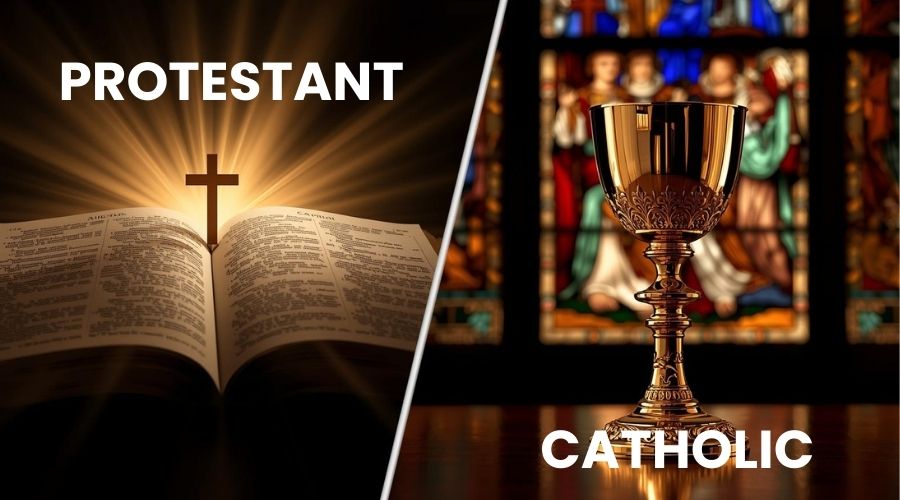
Protestant vs Catholic views on justification reveal contrasting perspectives on righteousness, grace, and assurance of salvation.
These differences are not merely theological abstractions but shape how believers understand their relationship with God, approach spiritual formation, and experience salvation.
Understanding these distinctions provides crucial insight into the ongoing theological conversation between these two major Christian traditions.
Why Protestants and Catholics Differ on Justification
Reformation Context
The Protestant Reformation of the 16th century erupted partly over the question of justification.
Martin Luther’s personal struggle with assurance of salvation led him to rediscover what he believed was the biblical teaching on justification by faith alone.
The prevailing late medieval Catholic practices, including indulgences and elaborate penitential systems, seemed to Luther to obscure the free gift of God’s grace.
His 95 Theses in 1517 challenged these practices, ultimately sparking a theological revolution.
The Reformers believed the Catholic Church had compromised the gospel by adding human works to faith as a requirement for justification, which they saw as undermining Christ’s finished work on the cross.
The Centrality of Justification for Both Traditions
Both Protestant and Catholic traditions recognize justification as essential to Christian salvation.
For Protestants, especially Lutherans, justification became the “article by which the church stands or falls”—the defining doctrine that determines the authenticity of Christian teaching.
Catholics equally affirm justification’s importance but place it within a broader sacramental framework of salvation.
The Council of Trent called justification “the greatest work of God” and devoted extensive attention to clarifying Catholic teaching on this doctrine.
Both traditions agree that justification is God’s gracious work through Christ’s redemptive sacrifice, but they diverge on the mechanics and nature of that work.
The Rise of Sola Fide vs Trent’s Response
The Protestant principle of sola fide (faith alone) became the rallying cry of the Reformation.
Reformers insisted that Scripture teaches justification comes through faith alone, apart from works of the law.
The Catholic Church responded definitively at the Council of Trent (1545-1563), which rejected sola fide and anathematized those teaching justification by faith alone without works.
Trent articulated a doctrine of justification that integrated faith, hope, and love, emphasizing the transformative nature of God’s justifying grace.
This formal doctrinal division solidified the theological separation between Protestantism and Catholicism, creating distinct understandings of salvation that persist today.
Do Catholics Believe in Sola Fide?
No, Catholics do not believe in sola fide(faith alone). The Catholic Church officially rejects the Protestant doctrine that salvation is by faith alone, teaching instead that justification comes through faith plus works, sacraments, and ongoing cooperation with God’s grace.
This is one of the most significant theological differences between Protestantism and Catholicism and remains a central point of division since the Reformation.
What is Sola Fide?
Sola fide is one of the five solas of the Protestant Reformation and means “faith alone.” It is the doctrine that a sinner is justified — declared righteous before God — by faith in Jesus Christ alone, apart from any works, sacraments, or human merit.
Romans 3:28 is the foundational verse: “For we maintain that a person is justified by faith apart from the works of the law.” Martin Luther famously called this doctrine “the article on which the church stands or falls.”
Protestants believe that justification is a one-time legal declaration where God imputes Christ’s righteousness to the believer the moment they place faith in Him.
Works are the evidence and fruit of genuine faith, but they do not contribute to justification itself. Ephesians 2:8-9 reinforces this: “For it is by grace you have been saved, through faith — and this is not from yourselves, it is the gift of God — not by works, so that no one can boast.”
Scripture at the Center of the Debate
Both sides appeal to Scripture but interpret key passages differently:
- Romans 4:5 — “To the one who does not work but trusts God who justifies the ungodly, their faith is credited as righteousness.” (Protestant emphasis)
- James 2:17 — “Faith by itself, if it is not accompanied by action, is dead.” (Catholic emphasis)
- Galatians 2:16 — “A person is not justified by the works of the law, but by faith in Jesus Christ.” (Protestant emphasis)
- Matthew 25:31-46 — The parable of the sheep and goats, where final judgment is based on works of mercy. (Catholic emphasis)
The Protestant response is that James is addressing false, intellectual faith that produces no fruit, not contradicting Paul’s doctrine of justification by faith alone.
The Catholic response is that Paul is rejecting works of the Mosaic law as a means of justification, not rejecting all works as cooperating with grace.
What Is Justification According to Protestant Theology?
Justification = God’s Legal Declaration of Righteousness
Protestant theology understands justification primarily as a forensic or legal declaration. God, acting as divine judge, declares the believer righteous based on Christ’s atoning work.
This declaration is external to the believer, it doesn’t make them inherently righteous but pronounces them righteous in God’s courtroom.
The emphasis is juridical: justification is God’s verdict of “not guilty” pronounced over sinners who deserve condemnation.
This legal framework draws heavily from courtroom imagery in Scripture, particularly Paul’s writings in Romans.
The believer’s actual moral condition doesn’t change at justification; rather, their legal standing before God changes from condemned to acquitted.
Imputed Righteousness of Christ
Central to Protestant justification is the concept of imputed righteousness. Christ’s perfect obedience and righteousness are credited or transferred to the believer’s account through faith.
This is often called the “Great Exchange”—Christ takes our sin and we receive His righteousness. The believer is clothed in Christ’s righteousness as an alien righteousness from outside themselves.
This imputation is immediate and complete at the moment of faith. Protestant theology emphasizes that believers possess Christ’s righteousness legally.
They are simultaneously sinners in themselves yet righteous before God through Christ (simul justus et peccator), a phrase particularly associated with Lutheran theology.
Justification Separate from Sanctification
Protestantism sharply distinguishes justification from sanctification.
They believe Justification is a one-time, completed legal act that establishes the believer’s righteous standing before God while Sanctification is the ongoing process of moral transformation that follows justification.
But is this biblical? For a detailed exegesis to clarify this belief, kindly read our teaching on Justification vs Sanctification.
Saved by Faith Alone
The Protestant doctrine of sola fide asserts that faith alone is the instrument by which justification is received.
Faith is not a work that merits salvation but the empty hand that receives God’s gracious gift. Faith unites the believer to Christ, and through that union, Christ’s righteousness becomes the believer’s possession.
This faith is not mere intellectual assent but wholehearted trust and reliance on Christ for salvation. The Reformers emphasized that adding anything to faith—whether works, sacraments, or human merit—compromises the gospel.
Ephesians 2:8-9 became a key text: salvation is by grace through faith, not of works. Faith alone ensures glory goes entirely to God.
Works as Evidence, Not Cause
While Protestants affirm justification by faith alone, they don’t deny the necessity of good works. Works are the inevitable evidence and fruit of genuine saving faith but never the cause or basis of justification.
James 2:17 (“faith without works is dead”) is understood to mean that true faith naturally produces obedience.
The order is crucial: faith leads to justification, which then produces works. Works demonstrate the reality of faith but don’t contribute to the righteousness that justifies.
This framework allows Protestants to maintain both salvation by grace alone and the necessity of holy living. Good works are the result of being saved, not the requirement for becoming saved.
What Is Justification According to Catholic Theology?
Justification = Being Made Righteous
Catholic theology views justification not merely as a legal declaration but as an actual transformation of the soul.
Justification makes the sinner righteous, not just declares them so. God’s grace doesn’t simply cover sin but removes it and imparts genuine righteousness to the believer.
This understanding emphasizes the real ontological change that occurs in justification, the person becomes a new creation, truly holy in God’s sight.
The Catholic perspective is that God’s declarative word accomplishes what it declares; when God pronounces someone righteous, that word has creative power to make them actually righteous.
This transformative view sees justification as the beginning of a journey of renewal.
Infused Righteousness
Rather than imputed righteousness, Catholic theology teaches infused righteousness. God pours sanctifying grace into the soul at justification, making the person intrinsically holy.
This infused grace is a supernatural quality that adheres to the soul, transforming its nature. The righteousness is truly the believer’s own, though it originates entirely from God’s grace.
Thomas Aquinas compared infused grace to light filling a room—it becomes part of the environment it transforms.
Infused righteousness grows through cooperation with grace, sacramental participation, and works of love.
This perspective maintains that God genuinely renews human nature rather than simply ignoring or covering sin while leaving the person fundamentally unchanged.
For a more detailed explanation on protestant and catholic views on righteousness, read our guide on imputed vs infused righteousness.
Justification and Sanctification Are United
Catholic theology does not separate justification from sanctification as distinct events. Justification includes both the forgiveness of sins and the sanctification or interior renewal of the soul.
These are two aspects of one continuous process of transformation. Initial justification occurs at baptism, but justification continues and increases throughout the Christian life.
Growth in grace and holiness is growth in justification itself. Catholics speak of an increase in justification as the believer cooperates with grace and advances in charity.
This unified understanding means justification is not merely a past event but an ongoing reality that must be maintained and can be lost through mortal sin.
Grace Received Through Sacraments
Sacraments are essential channels of justifying and sanctifying grace in Catholic theology.
Baptism is the sacrament of initial justification, washing away original sin and infusing sanctifying grace.
The Eucharist strengthens and increases justification by providing spiritual nourishment.
Confession restores justification when it has been lost through mortal sin. Each sacrament communicates grace ex opere operato—by the very performance of the sacramental action, when properly received.
This sacramental framework integrates justification into the liturgical and ecclesial life of the Church.
Grace is not merely a spiritual influence but a supernatural reality transmitted through physical signs instituted by Christ and administered by His Church.
Cooperation Through Works of Love
Catholic teaching emphasizes human cooperation with divine grace.
While grace is entirely God’s gift and the initiative is always His, humans must freely cooperate with grace through faith, hope, and charity.
Justification requires faith working through love (Galatians 5:6), meaning faith must be completed and perfected by loving actions.
Good works performed in grace have true merit before God and contribute to one’s growth in justification.
This doesn’t mean humans earn salvation, as all meritorious works are themselves enabled by grace.
Rather, God graciously rewards the works He Himself produces in believers. This cooperative model respects human freedom and dignity while maintaining divine primacy.
Faith Alone vs Faith Working Through Love
Protestant – Faith Is the Sole Instrument
Protestants maintain that faith alone, apart from any works, is the instrument through which justification is received.
Faith doesn’t justify because it’s a good work or meritorious act; rather, faith justifies because it looks away from self to Christ.
Faith is the open hand that receives the gift of righteousness; it contributes nothing but reception.
The Reformers insisted on this to preserve the graciousness of salvation and to direct trust entirely toward Christ.
Any addition to faith—whether love, works, or sacraments—compromises the sufficiency of Christ’s work and introduces human contribution.
Faith must be alone precisely because Christ and His righteousness are sufficient. This solitary role of faith protects the doctrine of grace alone.
Catholic – Initial Justification by Faith, but Must Be Completed in Love
Catholic theology affirms that initial justification is through faith but insists this faith must be living faith, working through love.
The Council of Trent taught that faith is the “beginning of human salvation, the foundation and root of all justification,” but faith alone, without hope and love, is insufficient.
Citing Galatians 5:6 (“faith working through love”), Catholics argue that justifying faith includes loving commitment to God, not just intellectual belief.
Faith and love are inseparable in Catholic thought; true faith naturally includes charity. A faith without love is “dead faith” or “unformed faith” that doesn’t justify.
This understanding integrates faith into the broader context of Christian discipleship and transformation by grace.
Role of Obedience
Both traditions affirm the importance of obedience but differ on its relationship to justification.
Protestants see obedience as the necessary fruit and evidence of justification, flowing from faith and demonstrating its genuineness.
Obedience doesn’t contribute to right standing before God but is the inevitable result of regeneration.
Catholics view obedience as part of ongoing justification, cooperating with grace to maintain and increase righteousness.
Obedience has meritorious value when performed in grace and contributes to final salvation.
This doesn’t mean earning salvation from God but receiving the reward God promises for faithful obedience enabled by His grace.
For Catholics, obedience is integral to the justification process; for Protestants, it’s consequent to justification.
James 2 (“Faith Without Works Is Dead”)
Did James 2:14-26 challenge both traditions? James declares that “faith without works is dead” , what does it really mean?
While Catholics see James as confirming their view that justification requires works of love, not faith alone.
They read James and Paul in harmony: faith working through love justifies, not bare faith. But what does the bible really teach in James 2 vs 14-26?
First, we have to know that there should be consistency in Bible interpretation, we shouldn’t have contradictions in major doctrines like salvation, faith, justification.e.t.c
“Works” in James 2 doesn’t mean activities or morality, for example, Abraham was not justified by his morality. Abraham believed in the resurrection of Christ in the promise.
Abraham demonstrated his faith in the promise of God by attempting to sacrifice Isaac, Hebrews 11 vs 17 – 19.
All the examples James used were the Old testament folks , for example, Rahab was a prostitute, this shows that the works James was referring to were not morality.
The “works” were activities carried out as the result of the promise of God. James was using the faith of the Old testament saints to teach walking in Love.
In other words, “walking in love is NOT WHAT SAVES US BUT IT SHOWS THAT WE HAVE BELIEVED THE GOSPEL.
Finally, every believer is expected to produce good conduct but good conduct is not SALVATION. We are SAVED TO PRODUCE GOOD WORKS!
Grace — Unconditional Gift or Enabling Power?
Protestant – Grace Alone Saves, No Merit
Protestant theology emphasizes sola gratia—grace alone. Salvation from beginning to end is God’s work and God’s gift.
Human beings contribute nothing to their salvation; they are spiritually dead and incapable of even desiring God apart from grace.
Grace is God’s unmerited favor and power that accomplishes salvation in its entirety. Justification is monergistic—God alone works.
There is no human merit before, during, or after justification. Even faith itself is God’s gift (Ephesians 2:8).
This understanding preserves the utter graciousness of salvation and ensures all glory goes to God.
Human response to grace is itself enabled by grace, so no ground for boasting remains. God’s unconditional grace is the sole cause of salvation.
Catholic – Grace Enables Cooperation With God
Catholic theology also affirms grace is absolutely necessary for salvation, but emphasizes that grace enables, not coerces, human cooperation.
Grace heals the will, enabling free choice to respond to God. Justification is synergistic—God and human will work together, though God’s grace always initiates and empowers.
Humans cooperate with grace through faith, hope, love, and good works. This cooperation doesn’t diminish grace’s necessity; rather, God’s grace includes empowering human freedom to participate in salvation.
Catholics argue this view respects human dignity and the genuine partnership God desires with His creatures.
Grace accomplishes salvation but does so by renewing human nature and enabling proper human response, not by overriding human will.
Role of Free Will
The understanding of free will differs between the traditions.
Protestants, especially those in the Reformed tradition, emphasize that fallen human will is enslaved to sin and incapable of choosing God without regenerating grace.
Free will is restored through regeneration, but salvation itself is entirely God’s sovereign work. Lutherans affirm human inability in spiritual matters while preserving freedom in civil matters.
Catholics maintain that even fallen human beings retain free will, though it is weakened and inclined toward evil.
Grace doesn’t override free will but heals and elevates it, enabling the proper response of faith and love.
Catholics emphasize God’s respect for human freedom—salvation requires human consent and cooperation, though entirely enabled by grace.
Merit (Condign vs Congruent Merit)
Catholic theology distinguishes between two types of merit. Congruent merit refers to God’s gracious decision to reward certain acts, though they don’t strictly deserve reward.
Condign merit refers to true merit where the act deserves the reward, though this is only possible through grace.
Believers in a state of grace can perform works of condign merit that truly deserve eternal life—not because the works are intrinsically worthy but because God has ordained to reward them.
This merit is always founded on grace; humans merit salvation through the grace Christ merited for them.
Protestants reject all language of merit, arguing it undermines grace and introduces human contribution. They see any merit-based system as inherently works-righteous.
The Role of Sacraments in Catholic Justification
Baptism as the Moment of Justification
In Catholic theology, baptism is the sacrament that accomplishes initial justification. Through baptism, original sin is washed away and sanctifying grace is first infused into the soul.
Baptism effects regeneration, making the person a child of God and member of Christ’s body.
This understanding is based on passages like John 3:5 (“born of water and Spirit”), Acts 2:38 (“be baptized for the forgiveness of sins”), and Titus 3:5 (“washing of regeneration”).
Baptism is necessary for salvation, though God is not bound by the sacraments. Infant baptism is practiced because baptism removes original sin and initiates children into the covenant community.
The sacrament itself, properly administered, conveys grace. To know more about regeneration, read our bible teaching on the difference between justification and regeneration.
Eucharist Strengthens Justification
The Eucharist, or Holy Communion, is the sacrament that sustains and increases justification throughout the Christian life.
Catholics believe the Eucharist truly contains Christ’s body and blood through transubstantiation. Receiving the Eucharist worthily provides spiritual nourishment that strengthens grace and increases charity.
It preserves the believer from mortal sin and deepens union with Christ. Jesus’s words “unless you eat the flesh of the Son of Man and drink His blood, you have no life in you” (John 6:53) are understood literally.
The Eucharist is the “source and summit” of Christian life, continually renewing and deepening the grace first received in baptism. Regular reception is necessary for maintaining and growing in justification.
Confession Restores Justification After Mortal Sin
Catholics distinguish between mortal and venial sin. Mortal sin—serious sin committed with full knowledge and deliberate consent—destroys sanctifying grace and justification in the soul.
The sacrament of Reconciliation (Confession) is the ordinary means by which justification is restored after mortal sin.
The sinner confesses sins to a priest, receives absolution, and performs penance. This sacrament is based on John 20:23, where Jesus gives the apostles authority to forgive sins.
Contrition, confession, and satisfaction are required. Through the priest’s absolution, God’s forgiveness is mediated and sanctifying grace is infused again.
This sacrament demonstrates the ecclesial dimension of sin and reconciliation—sin harms the Church, and restoration comes through the Church.
Sacraments as Channels of Infused Grace
Catholic theology teaches that sacraments are efficacious signs that actually confer the grace they signify.
They work ex opere operato—by the very performance of the act—when the recipient doesn’t place obstacles.
Sacraments are not mere symbols or human expressions of faith; they are divine instruments through which Christ Himself acts.
The seven sacraments (Baptism, Confirmation, Eucharist, Reconciliation, Anointing of the Sick, Holy Orders, Matrimony) each convey specific graces appropriate to different life situations.
God has chosen to bind Himself to these visible signs, though He can work outside them. This sacramental economy integrates grace into the communal, physical life of the Church and provides objective means of grace independent of subjective feelings.
Assurance of Salvation — Can You Know You Are Justified?
Protestants – Confident Assurance Based on Christ
Protestant theology generally teaches believers can have confident assurance of salvation. This assurance is based on the objective work of Christ, the promises of Scripture, and the inner testimony of the Holy Spirit.
Since justification is a completed legal act depending entirely on Christ’s righteousness, believers can be certain of their standing before God.
Faith looks to Christ’s finished work, not to subjective experience or personal performance. The Westminster Confession affirms believers “may in this life be certainly assured that they are in the state of grace.”
This assurance is not presumption but the proper response to God’s promises. It produces peace, joy, and motivation for holiness, not complacency.
Catholics – “Moral Certainty,” Not Absolute
Catholic teaching distinguishes between different types of certainty. While believers can have moral certainty or confident hope of salvation, absolute certainty is neither possible nor appropriate in this life.
The Council of Trent declared that no one can know “with the certainty of faith which cannot be subject to error” that they have obtained God’s grace.
This isn’t meant to create anxiety but humility—salvation depends on persevering in grace, which requires cooperation.
Catholics can have confident trust in God’s mercy while recognizing the real possibility of falling from grace through serious sin.
This position guards against presumption and maintains vigilance.
Hope, not certainty, characterizes the proper attitude of the Christian believer toward salvation.
Perseverance and Ongoing Grace
The question of perseverance differs between traditions. Most Protestants, especially in Reformed theology, believe true believers will necessarily persevere to the end because God preserves them.
Genuine faith cannot be permanently lost; those who fall away never truly believed. This is often called “eternal security” or “perseverance of the saints.”
Catholic theology teaches that believers can fall from grace through mortal sin, losing justification.
Perseverance is a gift that must be prayed for and cooperated with; it’s not automatic or guaranteed.
Final perseverance is necessary for salvation, but this requires continuing in grace throughout life. This difference reflects broader disagreements about the nature of grace and free will.
The Role of Hope
Both traditions affirm hope’s importance but emphasize it differently. Protestants emphasize present assurance based on Christ’s completed work, though they also speak of hope for future glorification.
Hope and assurance coexist, believers are assured of justification now and hope for consummation later.
Catholics emphasize hope as the proper theological virtue regarding salvation.
Hope is confident expectation based on God’s promises and mercy but acknowledges human weakness and the need for perseverance.
Hope is not doubt but realistic trust that combines confidence in God’s faithfulness with awareness of human frailty.
The theological virtue of hope is essential for the Christian journey and guards against both presumption and despair.
Biblical Passages at the Center of the Debate
Romans 3–5
Romans 3-5 contains Paul’s most extensive treatment of justification and is central to Protestant theology.
Romans 3:28 states “a person is justified by faith apart from works of the law,” the linchpin of Protestant doctrine.
Romans 4 uses Abraham as the exemplar of faith-based justification, emphasizing that his faith was “counted as righteousness.”
Romans 5:1 declares “having been justified by faith, we have peace with God.” Protestants read these chapters as clearly teaching forensic justification by faith alone.
Catholics interpret them as teaching justification by faith but not by faith alone, Paul opposes works of the Jewish law, not the works of love that faith produces. Both traditions see these chapters as foundational.
Galatians 2–3
Galatians addresses justification in the context of the Judaizer controversy. Galatians 2:16 states “a person is not justified by works of the law but through faith in Jesus Christ.”
Paul confronts Peter for withdrawing from Gentile fellowship, compromising the gospel of grace. Galatians 3 continues the argument, contrasting the law and faith.
Protestants see Galatians as Paul’s most forceful statement against works-righteousness. Catholics argue Paul opposes the Old Testament ceremonial law, not Christian works of charity.
The phrase “works of the law” is debated, does it mean all human works or specifically Torah observance?
This interpretive question shapes how these passages inform justification doctrine.
James 2
James 2:14-26 presents interpretive challenges because James explicitly states “a person is justified by works and not by faith alone” (v. 24).
James uses Abraham and Rahab as examples of faith demonstrated by works. Martin Luther famously struggled with James, calling it an “epistle of straw” for its apparent contradiction of Paul.
Protestants harmonize James and Paul by distinguishing the type of faith discussed, James addresses spurious faith, while Paul addresses genuine faith. James shows that real faith produces works.
Catholics see James as supporting their view that justification requires faith working through love.
Both traditions agree James doesn’t teach works-salvation but differ on how works relate to justification.(Read our explanation above for the correct interpretation)
John 3 and Regeneration Passages
John 3 contains Jesus’s teaching on being “born again” or “born from above,” essential for entering God’s kingdom.
Verse 5 mentions being “born of water and Spirit,” which Catholics understand sacramentally as baptismal regeneration.
Protestants typically distinguish the water (baptism) from the Spirit (regeneration), seeing baptism as outward sign rather than efficient cause.
Other regeneration passages (2 Corinthians 5:17, Titus 3:5, 1 Peter 1:23) describe the transformative work of new birth.
Both traditions affirm regeneration’s necessity but differ on whether it’s identical with justification or distinct, and on the role of sacraments.
These texts raise questions about the relationship between justification, regeneration, and sanctification.
Can Protestant and Catholic Views Be Reconciled?
The Joint Declaration on the Doctrine of Justification (1999)
In 1999, the Lutheran World Federation and the Catholic Church signed the Joint Declaration on the Doctrine of Justification, a landmark ecumenical achievement.
This document identified significant areas of consensus between Lutheran and Catholic positions while acknowledging remaining differences.
Both sides affirmed that salvation comes by grace through faith in Christ, that humans cannot justify themselves, and that justification is God’s work from beginning to end.
The Declaration stated that the mutual condemnations of the Reformation era don’t apply to the positions articulated in the document.
The World Methodist Council later affirmed the Declaration in 2006, followed by the World Communion of Reformed Churches in 2017.
Areas of Agreement
The Joint Declaration identified substantial common ground. Both traditions agree that God’s grace is absolutely necessary for salvation, that humans are totally dependent on God’s mercy, that Christ’s death and resurrection are the basis of justification, and that faith is essential.
Both reject Pelagianism (the idea humans can save themselves) and affirm original sin’s reality.
Both acknowledge that good works are necessary fruits of faith. Both affirm believers are simultaneously righteous and sinful in some sense.
These agreements suggest the theological distance is smaller than the polemics of the Reformation suggested.
Many differences involve emphasis, terminology, and conceptual framework rather than fundamental opposition.
Remaining Distinctions
Despite the agreements, significant differences remain. The forensic versus transformative understanding of justification continues to divide the traditions.
The role of imputation versus infusion, the relationship between justification and sanctification, the understanding of merit, the role of sacraments, and the nature of assurance remain disputed.
Some Protestants, especially Reformed theologians, argue the Lutheran-Catholic consensus concedes too much and doesn’t adequately represent Protestant theology.
Conservative Catholics express similar concerns about compromising Catholic distinctives. While the Joint Declaration achieved remarkable consensus, it hasn’t resolved all differences or achieved full communion.
The debate continues in theological literature, indicating these issues remain vital and contested among believers committed to their respective traditions.
FAQs — Protestant vs Catholic Justification
No, Catholics do not teach salvation by works. Catholic theology affirms salvation is by grace alone and that human beings cannot merit the grace of initial justification.
However, Catholics do teach that faith must be completed by love and works, and that believers in a state of grace can merit further grace and eternal life through their cooperation with God.
This is not Pelagianism (earning salvation) but synergism (cooperation with grace).
No, Protestants affirm obedience is necessary. The formula is “justified by faith alone, but not by a faith that is alone.”
Genuine saving faith inevitably produces good works. Protestants insist works are the result and evidence of justification, not the cause.
They distinguish between the ground of justification (Christ’s righteousness) and the fruit of justification (Christian obedience).
The thief on the cross who was promised paradise (Luke 23:43) is often cited in justification debates.
Protestants see him as clear evidence of salvation by faith alone, he couldn’t be baptized, perform good works, or receive sacraments, yet Christ assured him of salvation.
Catholics respond that the thief lived under the Old Covenant before the Church and sacraments were instituted, so he represents an exceptional case.
The Council of Trent pronounced anathemas (condemnations) on those who teach justification by faith alone.
From the Catholic perspective, sola fide undermines the transformative nature of grace, diminishes the importance of love, minimizes human cooperation with grace, and contradicts James 2:24.
Trent sought to defend Catholic teaching against what it viewed as theological error that would produce moral laxity. Protestants view these anathemas as condemning the biblical gospel.
Final Reflection — Why Justification Matters for Faith and Salvation
The doctrine of justification is not a mere theological abstraction but strikes at the heart of how we understand God’s saving work in human lives.
Both Protestant and Catholic traditions seek to honor Scripture, exalt God’s grace, and lead believers into deeper relationship with Christ.
Protestants emphasize the objectivity of salvation, the completeness of Christ’s work, and the assurance that comes from resting entirely on His righteousness.
Catholics emphasize the transformative power of grace, the genuine renewal of human nature, and the importance of cooperation with God’s sanctifying work.
These differences shape spirituality, pastoral practice, and the Christian life.
Despite genuine theological disagreements, both traditions confess Jesus Christ as Lord and Savior, affirm the Trinity, and embrace the historic Christian faith.
The debate over justification reveals different emphases rather than completely opposing gospels. As contemporary dialogue demonstrates, significant common ground exists alongside continuing distinctions.
Understanding these different perspectives enriches Christian theology and invites believers to deeper engagement with Scripture and tradition.
The question of how God justifies sinners remains central to Christian identity and demands continued theological reflection, always pointing believers toward the gracious God who saves through Jesus Christ.

My passion lies in reaching out to young adults in communities and schools, witnessing the transformative power of faith in their lives.
This blog extends my ministry, sharing insights, encouraging believers, and exploring Christ's teachings in daily life.
Welcome, Brother James.
- What Does the Bible Say About Culture and Traditions? - March 16, 2026
- Scriptural Prayers for Pastors and Leaders - March 16, 2026
- 100 Prosperity Scriptures - March 16, 2026