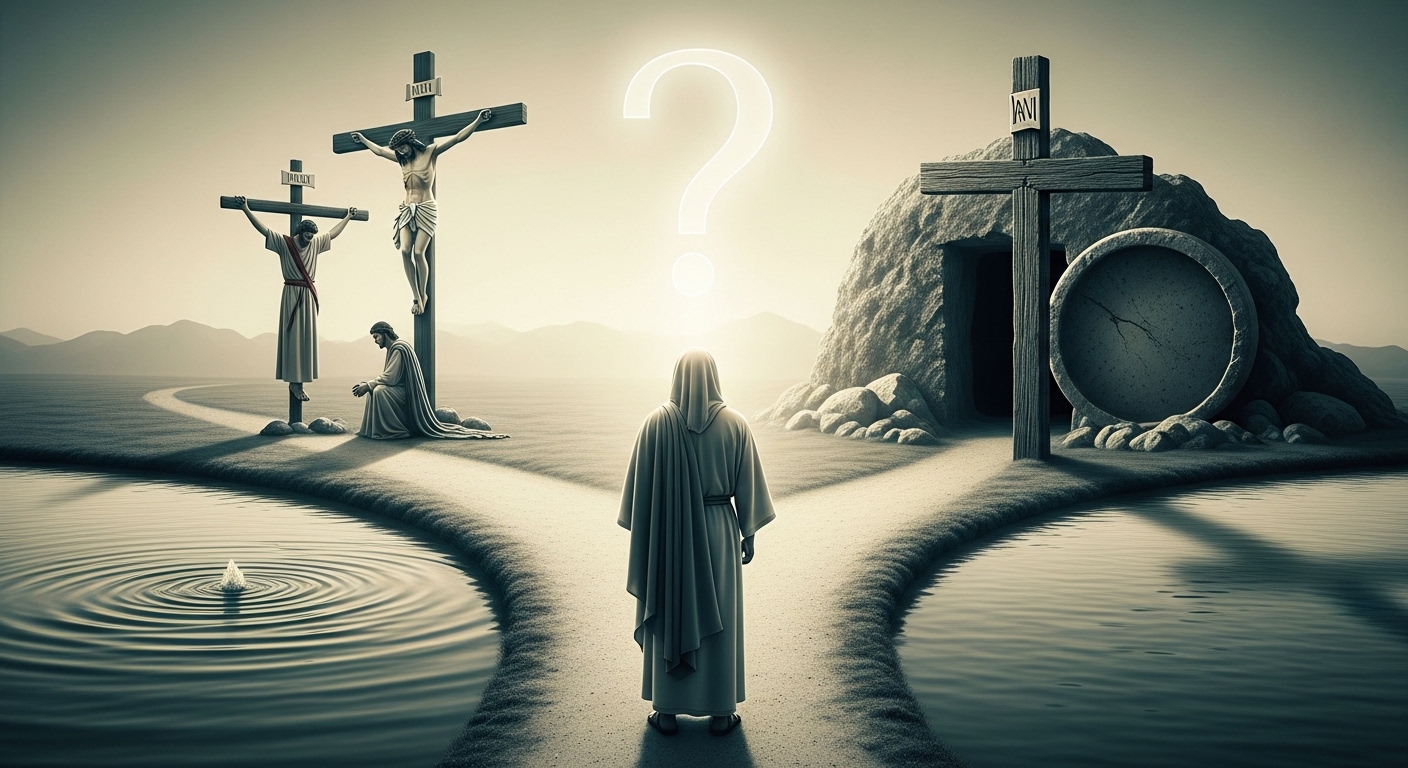
You want to follow Christ faithfully and secure your eternal destiny. But you’ve encountered the problem: conflicting teachings about baptism’s role in salvation leave you confused and uncertain about whether you’re truly saved.
You need clarity on whether baptism is necessary for salvation. Scripture becomes your guide, though Christians have interpreted key passages differently for centuries.
But today, we will carefully examine what the Bible teaches about salvation, explore verses connecting baptism and salvation, and understand how different traditions interpret this relationship.
This will help you determine whether baptism is an absolute requirement, a symbolic ordinance, or a necessary obedience flowing from faith.
For without proper understanding, you risk either false assurance or unnecessary anxiety about your salvation.
But what Scripture reveals about baptism’s relationship to salvation is clearly open in and will completely transform your understanding of how God saves and what He requires.
What Is Salvation According to the Bible?
Salvation represents God’s comprehensive work rescuing humanity from sin’s consequences, restoring broken relationships, and granting eternal life through Christ’s finished work.
Deliverance from Sin – Romans 6:23 declares, “For the wages of sin is death, but the gift of God is eternal life in Christ Jesus our Lord.”
Salvation delivers from sin’s penalty (eternal death), power (present bondage), and eventually presence (future glorification). It rescues from divine wrath, spiritual death, and Satan’s dominion.
Reconciliation with God – 2 Corinthians 5:18-19 explains that God reconciled us to Himself through Christ. Sin created enmity between the holy God and rebellious humanity; salvation restores a peaceful relationship.
Reconciliation addresses both legal standing (justification) and relational intimacy (fellowship). To know more about the benefits of salvation, read our bible expository on Justification vs salvation.
Eternal Life – John 3:16 promises eternal life for believers—not merely endless existence but qualitative life in God’s presence beginning now, continuing forever.
Salvation isn’t just escaping hell but gaining heaven, knowing God personally, and experiencing the abundant life Christ offers (John 10:10).
What Is Baptism?
Baptism represents Christianity’s initiatory rite, practiced universally across traditions despite varying interpretations of its meaning, subjects, and modes.
But is this really true? When you study the scriptures closely, you will notice that baptism is a teaching of immersion into union with Christ by which you receive the Holy Ghost. ( Read Acts Chapters 10, 13, 18, and 19)
Symbol of Death and Resurrection – Romans 6:3-4 describes baptism as participation in Christ’s death, burial, and resurrection: “We were therefore buried with him through baptism into death so that, just as Christ was raised from the dead through the glory of the Father, we too may live a new life.”
Immersion symbolizes dying to sin; emerging represents resurrection to new life. Immersion here doesn’t mean water but immersion in the holy spirit, one with the Holy Spirit.
Mark 16:15: And he said unto them, Go ye into all the world, and preach the gospel to every creature.
Verse 16: He that believeth and is baptized shall be saved; but he that believeth not shall be damned.
Matthew 28:18 – And Jesus came and spake unto them, saying, All power is given unto me in heaven and in earth.
Verse 19 – Go ye therefore, and teach all nations, baptizing them in the name of the Father, and of the Son, and of the Holy Ghost:
He said to go into all the world and preach what he has done, not what they have done. They are also not to preach what people are doing.
….He that believes and is baptized shall be saved, he that believes not is condemned.
Notice he did not say condemn people so that they can believe. It is when people do not believe that they are condemned.
The gospel is about what Jesus did in three days and three nights, so the gospel is not someone’s story. The gospel is Jesus’ story told to us by the Holy Spirit.
In Matthew 28:18-19, as quoted above, Jesus did not make the statement, “in the name of the Father and of the Son and the Holy Ghost.”
Why?
1. This statement does not exist anywhere else in the bible; that is, it has no corroboration.
2. He said all authority has been given to me. Not the name of the Father, Son, or Holy Ghost.
How do we know?
Mark 16:17 – And these signs shall follow them that believe; In my name shall they cast out devils; they shall speak with new tongues;
Luke 24:47 – And that repentance and remission of sins should be preached in his name among all nations, beginning at Jerusalem.
John 20:31 – But these are written, that ye might believe that Jesus is the Christ, the Son of God; and that believing ye might have life through his name. There is just one name: the name of Jesus.
Acts 2:21 – And it shall come to pass, that whosoever shall call on the name of the Lord shall be saved.
Romans 10:13 – For whosoever shall call upon the name of the Lord shall be saved.
They call upon the name of Jesus Christ; he did not say the name of the Father and of the Son and of the Holy Ghost. The name of Jesus Christ is the name given for men to be saved.
Philippians 2:9 – Therefore God exalted him to the highest place and gave him the name that is above every name, …God has highly exalted him….
Again, the word baptism does not mean water. Baptism simply means to be immersed into. To be incorporated into.
1Corinthians 10:1 – Moreover, brethren, I would not that ye should be ignorant, how that all our fathers were under the cloud, and all passed through the sea;
Verse 2 – And were all baptized unto Moses in the cloud and in the sea; Moses is not a sea. Moses here is the law; he doesn’t mention baptizing with water in this context.
Acts 1:5 – For John truly baptized with water; but ye shall be baptized with the Holy Ghost not many days hence.
Baptizing with water shows that baptism doesn’t have to do with water. Jesus must have been referring to the baptism of the Holy Ghost.
1st Corinthians 12:13 – For by one Spirit are we all baptized into one body, whether we be Jews or Gentiles, whether we be bond or free; and have been all made to drink into one Spirit.
Galatians 3:27 – For as many of you as have been baptized into Christ have put on Christ.
Hear Paul also, Ephesians 4:5 – One Lord, one faith, one baptism, that one baptism is baptism into Christ.
That phrase, “in the name of the Father and of the Son and of the Holy Ghost,” was a later addition to the text of the scriptures.
That statement is not consistent with the scriptures. We are baptized in the authority of Jesus, and that is the baptism of the Holy Ghost.
Is Baptism Necessary for Salvation?
According to Scriptures, Baptism isn’t necessary for salvation because it isn’t “water baptism” that gets you saved from sin, but the forgiveness of sins, which you received when the Gospel was preached to you!
Can you be saved without being baptized?
Yes, of course, you can be saved without being baptized by water. Salvation is purely the work of God, for while we were yet sinners Christ died for us.
Accepting what Christ did on your behalf is what got us saved.
Did Jesus say Baptism is required for Salvation?
Jesus never said baptism by water is required for SALVATION. Water used in scriptures was a symbol of the coming Holy Spirit, who is the Baptizer.
You might ask, but John the Baptist baptized Jesus with water. Jesus did that so that people could easily spot that he was the Messsahn especially John the Baptist; it was the clue to know that God had come down in human form to liberate man from his sins.
Can You Get to Heaven if you are not baptized?
This is just like asking if someone can be saved more than once. We have answered this in one of our bible discuss. Kindly read it.
Heaven is the believer’s reality now! We are NOT GOING TO HEAVEN, WE ARE ALREADY IN HEAVEN. Jesus said the kingdom of God is within us!
Having the seal of the Holy Spirit means you are already Heaven marked, which every believer who has the Holy Spirit has, yes, you. reading this now!
Therefore, you don’t need “water baptism” for you to make Heaven! It is the forgiveness of sins that we have received that has given us access to Heaven! Hallelujah!!
Bible Verses That Connect Baptism and Salvation
Several Scripture passages explicitly link baptism and salvation, requiring careful interpretation to understand their precise relationship and theological implications.
Baptism and Remission of Sins – Acts 2:38 commands, “Repent and be baptized, every one of you, in the name of Jesus Christ for the forgiveness of your sins.”
The Greek preposition eis (“for”) can mean “in order to obtain” or “because of”—suggesting baptism either obtains forgiveness or expresses already-received forgiveness. Contextual interpretation depends on broader biblical theology.
Does 1 Peter 3:21 mean baptism is a requirement for Salvation? No, Peter was simply explaining how the death of Jesus had given us victory and used the story of Noah as an example to explain salvation, the flood that came during the time of Noah, but in Christ, the baptism we have received now saves us – this baptism is Christ who has risen from the dead.
Born of Water and Spirit – John 3:5 records Jesus saying, “Very truly I tell you, no one can enter the kingdom of God unless they are born of water and the Spirit.”
“Water” here doesn’t mean “water baptism,” it is simply the Holy Spirit. Also, most evangelical interpreters understand “water” as spiritual cleansing by God’s Word, not a literal baptism requirement.
Bible Verses that Prove Baptism is not necessary for Salvation
Here are key scriptures that support the view that baptism is not necessary for salvation:
Faith Alone Passages:
- John 3:16 – “For God so loved the world that he gave his one and only Son, that whoever believes in him shall not perish but have eternal life.”
- John 3:18 – “Whoever believes in him is not condemned, but whoever does not believe stands condemned already because they have not believed in the name of God’s one and only Son.”
- John 5:24 – “Very truly I tell you, whoever hears my word and believes him who sent me has eternal life and will not be judged but has crossed over from death to life.”
- John 6:47 – “Very truly I tell you, the one who believes has eternal life.”
- Acts 16:31 – “Believe in the Lord Jesus, and you will be saved—you and your household.”
- Romans 3:28 – “For we maintain that a person is justified by faith apart from the works of the law.”
- Romans 4:5 – “However, to the one who does not work but trusts God who justifies the ungodly, their faith is credited as righteousness.”
- Romans 5:1 – “Therefore, since we have been justified through faith, we have peace with God through our Lord Jesus Christ.”
- Romans 10:9 – “If you declare with your mouth, ‘Jesus is Lord,’ and believe in your heart that God raised him from the dead, you will be saved.”
- Ephesians 2:8-9 – “For it is by grace you have been saved, through faith—and this is not from yourselves, it is the gift of God—not by works, so that no one can boast.”
- Galatians 2:16 – “Know that a person is not justified by the works of the law, but by faith in Jesus Christ.”
- Galatians 3:26 – “So in Christ Jesus you are all children of God through faith.”
- 1 John 5:1 – “Everyone who believes that Jesus is the Christ is born of God.”
- 1 John 5:13 – “I write these things to you who believe in the name of the Son of God so that you may know that you have eternal life.”
Example of Salvation Without Baptism:
- Luke 23:42-43 – The thief on the cross: “Jesus, remember me when you come into your kingdom.” Jesus answered him, “Truly I tell you, today you will be with me in paradise.” (He was saved without being baptized)
Abraham Justified Before Circumcision (Parallel to Baptism):
- Romans 4:9-11 – Abraham was justified by faith before receiving circumcision as a sign, establishing a pattern that the sign follows justification rather than causing it.
These verses emphasize that salvation comes through faith alone, without mentioning baptism as a requirement.
Major Christian Views on Baptism and Salvation
Christianity’s diverse traditions interpret baptism’s salvific role differently, producing distinct doctrines about its necessity, meaning, and proper administration.
Sacramental Traditions (Catholic, Orthodox, Lutheran) – These traditions teach baptismal regeneration—baptism is an ordinary means through which God applies Christ’s saving work.
Catholics view baptism as a sacrament conferring sanctifying grace, washing away original sin, and initiating the salvation process.
Orthodox similarly teach baptism as a mystery (sacrament) uniting believers with Christ’s death and resurrection, regenerating through water and Spirit.
See our bible study guide on how the Orthodox view the imputation of righteousness.
Evangelical View (Baptist, Non-denominational) – Most evangelicals view baptism as a symbolic ordinance, not a saving sacrament.
Baptism publicly declares salvation already received through faith alone. It’s necessary for obedience (commanded by Christ), important for discipleship, and normative for church membership—but not causally necessary for salvation. Faith alone saves; baptism expresses that faith externally.
Covenant Theology View (Presbyterian, Reformed) – Reformed traditions practice infant baptism, viewing it as a New Covenant sign corresponding to Old Covenant circumcision.
While not automatically conferring salvation, baptism marks covenant membership and obligates faithful response.
Salvation comes through faith, but baptism initiates one into a covenant community where faith is nurtured.
Restorationist Perspective (Churches of Christ) – Some Restorationist churches teach that baptism is when salvation occurs, the moment God forgives sins and adds believers to His church.
They emphasize Acts 2:38 and Mark 16:16 literally, insisting that baptism completes the conversion process. Faith, repentance, and baptism form an inseparable salvation package.
Is Baptism a Requirement, Means, or Sign?
Understanding baptism’s precise theological function clarifies whether it’s an absolute requirement, an instrumental means, or a symbolic sign of salvation already received through faith.
Instrumental Cause – Sacramental theology views baptism as an instrumental cause—God works through physical elements (water, words) to convey spiritual grace.
Baptism doesn’t merely symbolize grace but actually conveys it, making salvation effective. This view emphasizes God’s objective work through ordained means rather than subjective faith alone.
Sign of Inward Grace – Protestant evangelical theology typically views baptism as a sign pointing to inward grace already received through faith.
Like a wedding ring signifies marriage without creating it, baptism signifies salvation without causing it. Faith unites to Christ; baptism declares that union publicly.
This perspective, questioning how many times a person can be baptized, emphasizes baptism’s once-for-all nature, symbolizing singular conversion.
Pastoral Question: What If Someone Is Not Baptized?
Practical pastoral situations raise urgent questions about salvation for unbaptized individuals—infants, believers who die suddenly, or those lacking opportunity.
Thief on the Cross – Luke 23:43 records Jesus promising the crucified thief, “Today you will be with me in paradise.” This thief expressed faith, received salvation, but had no opportunity for baptism—demonstrating faith’s sufficiency when baptism proves impossible.
His example assures that God doesn’t mechanically deny salvation for lack of an external rite.
Intent vs Opportunity – Classical theology distinguishes baptism of water (sacramental), blood (martyrdom), and desire (intent).
Someone genuinely desiring baptism but prevented by death or circumstances possesses “baptism of desire”—God honors faithful intention even when external observance proves impossible.
This pastoral accommodation prevents mechanical salvation dependent on fortuitous circumstances.
Trusting God’s Mercy – Ultimately, unbaptized believers’ salvation rests on God’s character, not ritual perfection. God knows hearts, judges justly, and shows mercy generously.
While Christians should pursue baptism obediently, those prevented by death, disability, or ignorance can trust God’s gracious judgment.
Focus energy on faith and obedience rather than anxious scrupulosity about ceremonial perfection.

My passion lies in reaching out to young adults in communities and schools, witnessing the transformative power of faith in their lives.
This blog extends my ministry, sharing insights, encouraging believers, and exploring Christ's teachings in daily life.
Welcome, Brother James.
- What Does the Bible Say About Culture and Traditions? - March 16, 2026
- Scriptural Prayers for Pastors and Leaders - March 16, 2026
- 100 Prosperity Scriptures - March 16, 2026