One of Christianity’s most profound theological debates centers on how believers receive righteousness before God.
The distinction between imputed vs infused righteousness has shaped denominations, inspired reformations, and continues to influence how millions understand salvation today.
Imputed righteousness teaches that Christ’s perfect righteousness is credited to believers externally, declaring them just before God.
Infused righteousness, by contrast, holds that God’s grace is poured into the believer’s soul, transforming them internally and making them actually righteous.
This difference isn’t merely academic, it affects how we understand faith, works, sacraments, and the very nature of our relationship with God.
Understanding both perspectives enriches our grasp of Scripture and helps navigate centuries of Christian thought on justification and sanctification.
What Is Righteousness according to Scruptures?
Righteousness is the ability to stand before God with no iota of guilt, shame or condemnation. You stand a master over the devil and his works.
Righteousness is a gift that is imparted to the believer when he belives in the Gospel, which is the message that talks about the death, burial and resurrection of Jesus Christ.
Righteousness is instant, we don’t grow into righteousness nor lose our gift of righteousness, our good works adds nothing to the imputed righteosuness given to us at the new birth – when we received the life of God.
The Hebrew and Greek Roots (Tsedeq, Dikaiosune)
The Hebrew word “tsedeq” and Greek “dikaiosune” both convey rightness, justice, and conformity to a standard.
In the Old Testament, tsedeq often describes both God’s character and His saving acts on behalf of His people.
The Greek dikaiosune in the New Testament carries forensic overtones, particularly in Paul’s letters, where it frequently relates to courtroom language.
These terms describe not merely moral behavior but a state of being right before God, whether through covenant loyalty or legal standing.
Righteousness as Status vs Character
Scripture presents righteousness in one dimension, but many bible scholars see righteousness from not only a positional status but also personal character.
Status righteousness refers to one’s legal standing before God—being declared “not guilty” in His court. Character righteousness involves actual moral transformation and holy living.
However, we will stay with scriptures. It is the knowledge of “the free gift of righteousness” that you have received that brings character transformation or moral transformation.
Key emphasis on ” knowledge”, the debate between imputed and infused righteousness largely centers on which aspect dominates in justification.
Protestants typically emphasize status first, with character following.
Catholics and Orthodox believers see both as inseparable, viewing justification as including both declaration and transformation simultaneously.
God’s Righteousness as Standard
God Himself embodies perfect righteousness, serving as the ultimate standard by which all others are measured.
His righteousness is both retributive—judging sin justly—and redemptive—providing salvation. Human beings, fallen and sinful, cannot meet this standard through their own efforts.
The question becomes: How does God’s righteousness relate to sinners? Is it credited to them externally or infused within them?
Both perspectives affirm that God’s righteousness is essential for salvation; they differ on the mechanism by which believers receive it.
What Is Imputed Righteousness? (Protestant View)
Imputed righteousness stands as a cornerstone of Protestant theology, particularly within Reformed traditions.
This doctrine teaches that justification is God’s legal declaration pronouncing sinners righteous based on Christ’s perfect obedience.
Rather than making believers internally righteous, God counts Christ’s righteousness as theirs. This forensic transaction happens at the moment of faith, entirely apart from any human merit or moral improvement.
Christ’s Righteousness Credited to the Believer
In imputation, Christ’s perfect life and obedience are credited to the believer’s account, much like a financial transaction.
Jesus lived the righteous life humanity could not, perfectly fulfilling God’s law. Through faith, believers receive the legal benefits of His obedience.
Simultaneously, their sins are transferred to Christ, who bore their punishment on the cross. This double imputation—sins to Christ, righteousness to believers—forms the heart of substitutionary atonement.
The believer stands before God clothed in Christ’s righteousness, not their own.
Based on Romans 4 (Abraham Credited Righteous)
Paul’s argument in Romans 4 provides the biblical foundation for imputed righteousness. Abraham “believed God, and it was credited to him as righteousness” (Romans 4:3).
The verb “credited” (logizomai) is an accounting term meaning to reckon or count something to someone’s account.
Paul emphasizes Abraham received this righteousness through faith before circumcision, before the law, and before any works.
This pattern establishes justification by faith apart from works as the fundamental principle of salvation history.
External, Objective Righteousness
Imputed righteousness remains external to the believer, it is Christ’s righteousness, not something produced within the individual.
This objectivity provides assurance: salvation doesn’t depend on the fluctuating state of one’s inner holiness but on Christ’s finished work.
Even as believers struggle with remaining sin, their legal status before God remains secure because it rests on Christ’s perfect record, not their imperfect progress.
This external righteousness becomes the ground of justification, while internal transformation follows as sanctification.
“Alien Righteousness” (Luther)
Martin Luther coined the term “alien righteousness” (iustitia aliena) to emphasize that justifying righteousness comes entirely from outside the sinner.
It is foreign, external, and completely Christ’s. Luther contrasted this with “proper righteousness”—the actual holiness God works within believers through sanctification.
This distinction protected the gospel from becoming dependent on human achievement.
Alien righteousness means believers never stand before God on the basis of their own holiness, even Spirit-wrought holiness, but always on Christ’s righteousness alone.
What Is Infused Righteousness? (Catholic & Orthodox View)
Infused righteousness represents the Catholic and Orthodox understanding of how God saves sinners.
Rather than merely declaring righteousness, God actively pours grace into the soul, transforming it and making it truly holy.
Justification involves both forgiveness and renewal—God doesn’t merely treat believers as righteous but makes them righteous through the Holy Spirit’s indwelling presence.
This righteousness is real, internal, and transformative.
Grace Infused into the Believer’s Soul
In Catholic theology, sanctifying grace is infused into the soul at baptism, creating a real ontological change in the person.
This isn’t merely a legal fiction or external declaration but an actual transformation of the soul’s nature.
Grace becomes a supernatural quality residing in the believer, enabling them to live righteously and grow in holiness.
This infused grace can increase through faithful cooperation and the sacraments, or decrease through mortal sin.
It represents God’s life truly shared with humanity.
Righteousness as Moral Renewal
Infused righteousness emphasizes actual moral transformation, not just a change in legal status.
When God justifies, He genuinely makes people just, not merely declares them so while they remain unchanged.
This renewal involves the healing of sin’s effects, the restoration of the image of God, and the progressive conformity to Christ’s likeness.
Righteousness is not an external covering but an internal reality. Faith works through love, producing genuine holiness that makes believers fit for heaven.
Received Through Sacraments (Especially Baptism)
The sacraments, particularly baptism, serve as the ordinary means by which God infuses righteousness.
Baptism washes away original sin and infuses sanctifying grace, initiating the process of justification.
The Eucharist nourishes and increases this grace. Penance restores grace lost through mortal sin.
These sacraments are not merely symbolic but effective signs that actually convey the grace they represent.
Through them, God’s transforming power enters the soul, making justification an ecclesial reality mediated through the Church.
Justification and Sanctification as a Unified Process
Catholic theology does not sharply separate justification from sanctification. Both are aspects of one reality: God making sinners holy.
Justification includes both the forgiveness of sins and the sanctification and renewal of the inner person.
This process begins at baptism and continues throughout life as believers grow in grace.
Rather than a one-time declaration, justification is an ongoing reality that can increase or, tragically, be lost through mortal sin and restored through repentance.
Cooperation with Grace (Synergism)
Infused righteousness involves human cooperation with divine grace. While grace always precedes and enables human response, believers must freely cooperate with God’s transforming work.
Faith works through love; believers must choose obedience, practice virtue, and persevere in holiness.
This cooperation doesn’t earn salvation but is the necessary response to grace. God respects human freedom, inviting partnership in the work of sanctification.
Salvation remains God’s gift, but it requires human acceptance and ongoing collaboration.
Imputed vs Infused Righteousness — Core Differences
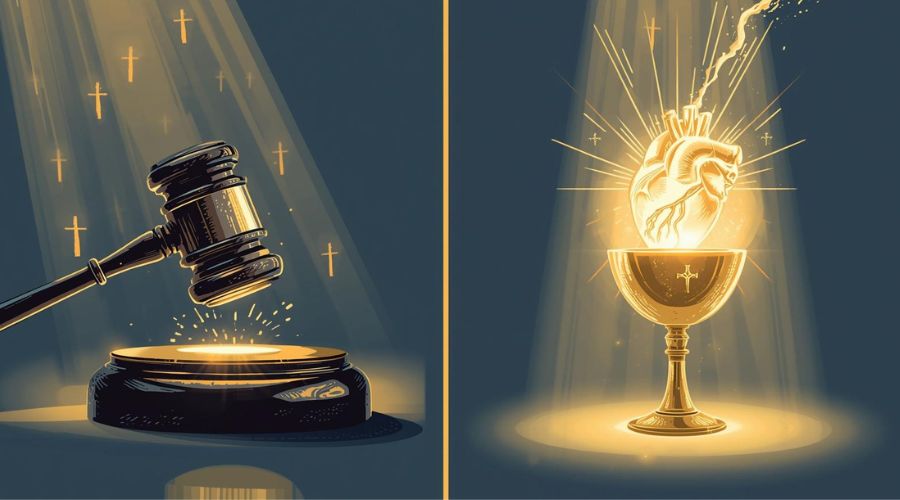
The debate between imputed and infused righteousness reveals fundamentally different approaches to justification, though both traditions affirm salvation by grace.
Understanding these differences clarifies centuries of theological division and ongoing ecumenical dialogue.
The contrasts touch on the nature of righteousness itself, the mechanism of justification, and the relationship between faith and works.
Nature of Righteousness
Imputed righteousness is external and legal, Christ’s righteousness credited to believers’ accounts without changing their inherent condition.
Infused righteousness is internal and transformative, grace poured into the soul, actually making believers righteous.
The imputed view emphasizes forensic declaration; the infused view emphasizes ontological transformation.
One focuses on legal status before God’s court; the other on real moral renewal.
Both affirm believers need Christ’s righteousness, but differ on whether it remains His or becomes theirs internally.
How Justification Operates
In the imputed framework, justification is God’s once-for-all legal verdict pronounced at the moment of faith, declaring sinners righteous based on Christ’s work.
It is instantaneous, complete, and irreversible. In the infused framework, justification is a process that begins at baptism and continues throughout life.
It can increase through cooperation with grace or be lost through serious sin.
The imputed view sees justification as declarative and permanent; the infused view sees it as transformative and progressive.
Role of Faith vs Works
Protestantism affirms justification by faith alone (sola fide)—faith is the sole instrument receiving Christ’s righteousness, with works following as fruit.
Catholicism teaches faith must work through love to justify—faith and works cooperate in the ongoing process of justification.
The imputed view separates faith as the means of justification from works as evidence of genuine faith.
The infused view integrates faith and love, seeing living faith as necessarily productive of good works that contribute to the justification process.
Permanent Declaration vs Ongoing Transformation
Imputed righteousness provides certainty: once declared righteous, believers cannot lose their justified status because it rests on Christ’s unchanging merit.
Infused righteousness makes assurance more conditional: believers must persevere in grace, cooperating with God’s transforming work throughout life.
The imputed view offers objective confidence based on Christ’s finished work. The infused view emphasizes subjective faithfulness and warns against presumption.
One prioritizes assurance; the other prioritizes holy living as essential to maintaining justification.
For more detailed study, read our bible research guide on the difference between Protestants and Catholic views on the doctrine of Justification.
Biblical Arguments for Imputed Righteousness
Protestant theology marshals numerous scriptural texts supporting forensic justification through imputed righteousness.
Paul’s letters, especially Romans and Galatians, form the primary biblical basis.
These passages emphasize righteousness credited by faith apart from works, establishing the legal framework for understanding salvation.
The pattern of Abraham’s justification serves as the paradigm for all believers.
Romans 3–5
Romans 3–5 contains Paul’s most concentrated teaching on justification by faith.
Romans 3:21-26 declares righteousness comes “apart from the law” through faith in Christ’s atoning sacrifice.
Romans 4 uses Abraham as the prime example of credited righteousness—he “believed God, and it was credited to him as righteousness.”
Romans 5:1 states, “having been justified by faith, we have peace with God.”
The consistent emphasis falls on righteousness received through faith, not produced by works, establishing justification as God’s declarative act.
2 Corinthians 5:21 (“He Became Sin…”)
This verse captures the substitutionary exchange central to imputed righteousness: “God made him who had no sin to be sin for us, so that in him we might become the righteousness of God.”
Christ bore our sin; we receive His righteousness. The language suggests a transfer or imputation—Jesus took our sin upon Himself, and believers receive His righteousness in return.
This double imputation forms the heart of penal substitution, showing justification depends entirely on Christ’s work.
Philippians 3:9
Paul contrasts two kinds of righteousness: “not having a righteousness of my own that comes from the law, but that which is through faith in Christ, the righteousness that comes from God on the basis of faith.”
Paul explicitly rejects self-achieved righteousness in favor of righteousness received through faith.
This righteousness “comes from God,” emphasizing its external source. The verse distinguishes clearly between human-generated righteousness and divinely-given righteousness, supporting the concept of alien righteousness credited to believers.
Abraham as Prototype of Credited Righteousness
Abraham’s justification in Genesis 15:6, expounded in Romans 4 and Galatians 3, establishes the pattern for all who believe.
Abraham was justified by faith before circumcision, before the law, and before any works.
Paul uses accounting language—righteousness was “credited” (logizomai) to Abraham’s account.
This crediting happened through faith alone, apart from works.
Abraham thus becomes the father of all who believe, demonstrating that justification has always operated by grace through faith, with righteousness imputed rather than earned.
Biblical Arguments for Infused Righteousness
Catholic and Orthodox traditions find strong scriptural support for infused righteousness, particularly in texts emphasizing moral transformation and the necessity of works flowing from faith.
While Protestants see these passages as describing sanctification, Catholic theology views them as integral to justification itself.
The emphasis falls on faith’s transformative power and the requirement of holy living. To learn more about the Orthodox view, read our study on: How does God impute his righteousness?
James 2 — “Faith Without Works Is Dead”
James 2:14-26 explicitly states that faith without works cannot save and uses Abraham’s willingness to sacrifice Isaac as evidence of justifying faith. “You see that a person is justified by what he does and not by faith alone” (James 2:24).
While Protestants interpret James as describing evidential faith, Catholics see actual justifying significance in works done in grace.
James presents faith and works as cooperating realities, not separated stages. True, living faith necessarily produces works that participate in justification.
Matthew 5–7 — Holiness as Required
Jesus’ Sermon on the Mount describes kingdom righteousness exceeding that of scribes and Pharisees (Matthew 5:20).
Jesus requires actual holiness: purity of heart, reconciliation with brothers, love for enemies.
He warns that not everyone who calls Him “Lord” will enter heaven, “but only he who does the will of my Father” (Matthew 7:21).
These teachings emphasize real moral transformation and obedient living as essential for salvation, supporting the view that justification involves actual righteousness, not merely declared status.
John 15 — Abiding and Bearing Fruit
Jesus teaches believers must abide in Him to bear fruit, warning that branches not bearing fruit are cut off and thrown into the fire (John 15:1-8).
This imagery suggests salvation requires ongoing connection to Christ that produces visible results. The transformative relationship with Christ yields genuine spiritual fruit—love, obedience, holiness.
This supports infused righteousness: believers participate in Christ’s life, receiving His grace internally, which transforms them and produces good works as necessary evidence of genuine faith.
Titus 3:5–7 — Regeneration and Renewal
Paul writes that God “saved us through the washing of rebirth and renewal by the Holy Spirit, whom he poured out on us generously through Jesus Christ our Savior, so that, having been justified by his grace, we might become heirs” (Titus 3:5-7).
The language of washing, rebirth, renewal, and the Spirit being “poured out” suggests internal transformation, not merely external declaration.
Justification connects directly with regeneration and the Spirit’s renewing work, supporting the Catholic view of justification as transformative, not purely forensic.
How Justification Relates to Sanctification
The relationship between justification and sanctification represents one of the most significant theological divides between Protestant and Catholic traditions.
Both affirm God justifies and sanctifies believers, but they differ fundamentally on whether these are distinct acts or aspects of one unified reality.
This distinction affects assurance, the role of works, and practical Christian living.
Protestant Distinction (Declared vs Becoming)
Classical Protestant theology distinguishes justification (being declared righteous) from sanctification (becoming actually holy).
Justification is a once-for-all legal pronouncement that changes one’s status before God. Sanctification is the lifelong process that changes one’s character.
Justification is entirely God’s work received passively through faith; sanctification involves active cooperation with the Spirit.
This distinction ensures that assurance rests on the completed work of Christ in justification, not the incomplete process of sanctification. It protects against basing salvation on personal holiness.
Catholic Unity (Justification Includes Transformation)
Catholic theology rejects this sharp division, viewing justification and sanctification as inseparable aspects of God’s saving work.
When God justifies, He simultaneously forgives sins and renews the inner person through infused grace.
Justification is not merely declarative but transformative from the start. The process begun in baptism continues throughout life as believers grow in sanctifying grace.
This unified view emphasizes that God’s declaration of righteousness corresponds to a real, though incomplete, internal righteousness that progressively increases through cooperation with grace.
Role of the Holy Spirit
Both traditions affirm the Holy Spirit’s essential role, though with different emphases.
Protestants see the Spirit applying Christ’s work in justification and then progressively sanctifying believers throughout life. The Spirit’s work in sanctification follows and demonstrates justification.
Catholics emphasize the Spirit infusing grace at baptism, dwelling within believers, and continuously transforming them.
The Spirit’s presence creates real, internal righteousness that grows through the sacraments and faithful cooperation.
Both views honor the Spirit’s work, but differ on its relationship to justification.
Lifelong Growth in Righteousness
Both Protestant and Catholic Christians affirm believers must grow in holiness throughout life but the right interpretation of scriptures doesn’t subscribe to this teaching.
Protestants see this growth as sanctification flowing from justification, believers already declared righteous progressively become what they are positionally.
Catholics view growth as increasing justification itself, believers move from initial justification toward final glorification, growing in infused grace.
Both reject the idea that initial salvation completes the transformation, insisting on perseverance and spiritual maturity. The difference lies in whether growth affects one’s justified status or demonstrates it.
How Righteousness Is Received — Faith, Sacraments & Works
The means by which believers receive righteousness represents another crucial difference between Protestant and Catholic theology.
Both affirm God’s grace as the source of salvation, but they differ on the instruments through which grace operates.
Faith, sacraments, and works play varying roles depending on one’s theological framework.
Faith as Sole Instrument (Imputed View)
Protestant theology teaches faith alone (sola fide) as the instrument receiving Christ’s righteousness. Faith is not a work or human contribution but the empty hand that receives God’s gift.
It is the means, not the ground, of justification, the ground is always Christ’s work. Faith unites believers to Christ, so His righteousness is credited to them.
Any addition to faith—sacraments, works, or human effort—compromises the gospel by introducing human merit.
This preserves salvation as entirely gracious, dependent solely on Christ’s finished work.
Baptism as Beginning of Justification (Infused View)
Catholic theology views baptism as the ordinary means by which God infuses justifying grace.
Baptism washes away original sin, imparts sanctifying grace, and initiates the Christian life. It is not merely symbolic but sacramentally effective, it accomplishes what it signifies.
Through baptism, one becomes a new creation, justified and incorporated into Christ’s body. While faith is necessary, it works through baptism (and other sacraments) to receive and increase grace.
The sacramental system provides tangible, ecclesial means by which God distributes His saving grace.
Works as Fruit vs Works as Cooperation
Protestants view good works as the inevitable fruit of genuine faith and evidence of justification, but they contribute nothing to justification itself.
James speaks of works demonstrating faith, not earning salvation. Works follow justification and sanctification, flowing naturally from regenerate hearts indwelt by the Spirit.
Catholics see works as cooperation with grace that contribute to the ongoing process of justification.
Works done in grace merit increase in sanctifying grace and even eternal life, not as payment but as God’s gracious reward for faithful cooperation.
Role of Perseverance
Both traditions affirm believers must persevere, though with different implications for assurance.
Protestants teach genuine faith produces perseverance, those truly justified will endure to the end, though their assurance rests on Christ’s work, not their performance.
Catholics emphasize believers must persevere in grace to reach final salvation, cooperating with God throughout life.
One can lose justification through mortal sin and must be restored through penance.
This makes perseverance a condition of final salvation, not merely evidence of it, creating a different approach to Christian assurance.
Historical Background — Reformation vs Trent
The Protestant Reformation and Catholic Counter-Reformation crystallized opposing views on righteousness, justification, and salvation.
Understanding this historical context illuminates why these theological differences matter and how they shaped Christian tradition.
The debates of the 16th century still influence Protestant-Catholic relations today, though modern ecumenical efforts have sought common ground.
Luther’s Discovery of Forensic Righteousness
Martin Luther’s theological breakthrough came through studying Romans 1:17: “The righteous will live by faith.”
Luther realized God’s righteousness is not primarily a standard condemning sinners but a gift imputed to believers through faith.
This forensic understanding liberated Luther from works-righteousness and became the heart of Protestant theology.
Justification by faith alone, based on Christ’s alien righteousness, became the “article by which the church stands or falls.” Luther’s insight sparked the Reformation, challenging medieval Catholic theology.
Council of Trent’s Decree on Justification
The Council of Trent (1545-1563) formulated Catholicism’s official response to Protestant teaching.
Trent’s Decree on Justification (1547) affirmed justification by grace through faith but condemned sola fide.
It defined justification as not merely forgiveness but also sanctification and renewal. Trent taught justification could increase and be lost, requiring sacramental restoration.
It anathematized anyone teaching justification by faith alone without works or that assurance was possible.
Trent preserved Catholic emphasis on infused righteousness and sacramental mediation against Protestant claims.
Points of Agreement and Disagreement
Despite deep divisions, both sides agreed on crucial points: salvation by grace, the necessity of faith, Christ’s atoning work, and the call to holiness.
They disagreed fundamentally on the nature of justifying righteousness (imputed vs infused), the role of works (evidence vs cooperation), the sacraments’ efficacy, and the possibility of assurance.
The Reformation debates centered on whether justification is primarily legal or transformative, instantaneous or progressive, and whether faith alone or faith working through love justifies.
Modern Ecumenical Dialogues
Since Vatican II, Catholic-Protestant dialogue has sought common ground.
The 1999 Joint Declaration on the Doctrine of Justification between Lutherans and Catholics acknowledged significant agreement while maintaining differences.
Both sides affirmed justification by grace through faith and condemned works-righteousness.
Differences remain on the sufficiency of faith alone, the role of sacraments, and the nature of cooperation with grace.
These dialogues show that mutual understanding is possible while acknowledging that substantial theological differences persist on imputed versus infused righteousness.
FAQs — Imputed vs Infused Righteousness
No. Imputed righteousness is a legal reality, not fiction. God truly declares believers righteous based on Christ’s actual obedience and substitutionary death.
The righteousness is real, Christ genuinely lived a perfect life and died for sins. What is imputed is Christ’s accomplished righteousness, credited to believers through union with Him by faith.
This is analogous to how Adam’s sin is imputed to humanity, a real transfer of legal status.
The declaration corresponds to Christ’s real righteousness, making believers legally righteous before God’s court even while sanctification continues.
Catholics affirm salvation by grace alone in the sense that grace initiates, enables, and completes salvation.
However, they reject the Protestant formula of grace alone, faith alone, apart from works.
Catholics teach that grace requires human cooperation, believers must freely accept grace and cooperate with it through faith working in love.
This cooperation doesn’t earn salvation but is grace-enabled response.
The disagreement isn’t whether grace is necessary but whether grace works monergistically (God alone) or synergistically (God and human cooperation) in justification.
Some theologians propose both concepts capture biblical truth from different angles—imputed righteousness addresses legal standing before God, while infused righteousness describes internal transformation.
God declares righteous (imputation) while simultaneously making righteous (infusion). This mediating position sees justification and sanctification as distinguishable but inseparable.
However, traditional Protestant and Catholic positions remain distinct: Protestants prioritize imputation with sanctification following; Catholics see infusion as essential to justification itself.
The debate continues over whether these views can be harmonized or remain fundamentally incompatible theological systems.
Final Reflection — The Glory of God’s Righteousness in Salvation
Both imputed and infused righteousness point to the magnificent truth that God saves sinners.
The Protestant emphasis on imputed righteousness protects the gospel’s objectivity—salvation rests entirely on Christ’s work, not our fluctuating progress.
This provides profound assurance and magnifies God’s grace.
The Catholic emphasis on infused righteousness honors God’s transformative power, He doesn’t merely declare but actually makes believers holy through indwelling grace.
This emphasizes genuine renewal and moral accountability.
Perhaps both perspectives capture complementary biblical truths. God does credit Christ’s righteousness to believers, and He does transform them by His Spirit.
The legal and transformative aspects of salvation both glorify God—His justice satisfied through Christ’s substitution and His power displayed through the Spirit’s sanctification.
Whatever our theological tradition, all Christians can celebrate that God provides the righteousness we lack, whether understood as imputed, infused, or both, securing our salvation from beginning to end.

My passion lies in reaching out to young adults in communities and schools, witnessing the transformative power of faith in their lives.
This blog extends my ministry, sharing insights, encouraging believers, and exploring Christ's teachings in daily life.
Welcome, Brother James.
- What Does the Bible Say About Culture and Traditions? - March 16, 2026
- Scriptural Prayers for Pastors and Leaders - March 16, 2026
- 100 Prosperity Scriptures - March 16, 2026