The question of how a holy, righteous God can accept sinful humanity stands at the heart of Christian theology.
Throughout history, countless souls have wrestled with the weight of their moral failures, wondering if redemption is truly possible.
The concept of divine justification addresses this profound human need, offering hope to those burdened by guilt and separated from their Creator.
How does God justify a sinner? This question isn’t merely academic, it touches the deepest longing of the human heart for acceptance, forgiveness, and restoration.
The biblical answer reveals a stunning display of divine wisdom, where justice and mercy meet at the cross of Jesus Christ.
Through a legal declaration grounded in Christ’s substitutionary work, God accomplishes what seems impossible: He declares guilty sinners righteous without compromising His holy character.
Understanding this doctrine transforms how we view God, ourselves, and the gospel message that has changed millions of lives.
What Does ‘Justify’ Mean?
The term “justify” in biblical theology carries profound legal significance that shapes our understanding of salvation.
Unlike contemporary usage where justification often means explaining or excusing behavior, the biblical concept is forensic—rooted in courtroom language.
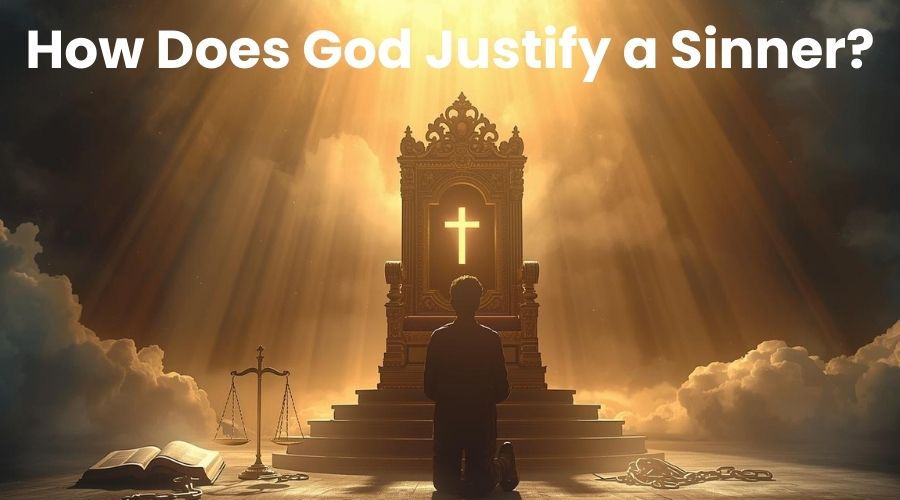
When God justifies a sinner, He issues a legal verdict, a divine declaration that changes the sinner’s standing before the throne of heaven.
This isn’t about making someone morally perfect in their daily conduct; rather, it’s about pronouncing them legally righteous in God’s sight.
This legal framework provides the foundation for understanding how sinners gain right standing with a holy God without God compromising His justice or lowering His righteous standards.
Courtroom Imagery: God as Judge
Scripture consistently portrays God as the ultimate Judge who presides over humanity’s moral accountability.
In this divine courtroom, every person stands as a defendant awaiting verdict. God sits on the judgment seat with perfect knowledge of every thought, word, and deed.
Unlike earthly judges who may be deceived or corrupted, God’s judgment proceeds from omniscience and absolute righteousness.
The imagery is sobering: humanity stands accused, with the Law serving as prosecutor, presenting irrefutable evidence of guilt.
Yet this same Judge who cannot ignore sin also provides the means of acquittal. The courtroom metaphor helps us grasp the gravity of sin and the wonder of grace—we deserve condemnation, yet God offers justification.
Justification = “Declared Righteous,” Not “Made Righteous”
This distinction represents one of the most important clarifications in Christian doctrine. Justification is declarative, not transformative.
God doesn’t justify sinners by gradually improving their moral performance until they meet His standards.
Instead, He pronounces them righteous based on factors outside themselves. The moment of justification doesn’t eliminate all sinful tendencies or perfect behavior; it changes legal status.
Think of a judge declaring a defendant “not guilty”—the verdict changes their standing before the law immediately, regardless of their character development.
This declaration, however, is not fictional or arbitrary. It’s grounded in the real righteousness of Christ credited to the believer’s account.
God doesn’t pretend sinners are righteous; He declares them righteous based on Christ’s perfect obedience.
Contrast with Condemnation
Justification and condemnation stand as polar opposites in the biblical narrative. Condemnation means being found guilty and sentenced to punishment—eternal separation from God.
Every human being outside of Christ remains under this condemnation due to sin’s universal presence.
Romans 8:1 declares, “There is therefore now no condemnation to them which are in Christ Jesus.” This verse captures the dramatic reversal that justification brings.
Where condemnation once stood as our certain destiny, justification erases the guilty verdict entirely. The condemned prisoner becomes a justified child of God.
This isn’t a suspended sentence or probation; it’s complete acquittal. God doesn’t merely reduce the sentence—He removes condemnation altogether for those united to Christ by faith.
Conviction vs Condemnation: The Key Differences
Conviction and condemnation may feel similar, but they come from different sources and produce opposite results. Understanding the difference is essential to walking in freedom as a justified believer.
| Conviction | Biblical Truth: Romans 8:1 — “There is no condemnation for those in Christ Jesus.” |
|---|---|
| Greek Word: Elegcho (ἐλέγχω) — to expose, reprove, correct with the intent to restore | Greek Word: Katakrima (κατάκριμα) — judgment against, guilty verdict with penalty |
| Source: The Holy Spirit (John 16:8) | Source: Satan, the accuser (Revelation 12:10) |
| Purpose: To restore and bring you closer to God | Purpose: To shame and push you away from God |
| Tone: Specific about the sin, but affirming of your identity in Christ | Tone: Attacks your identity and worth as a person |
| Outcome: Leads to repentance, freedom, and peace (2 Corinthians 7:10) | Outcome: Leads to shame, despair, and hiding from God |
| Message: “That was sin — confess it, and I will forgive you” | Message: “You are a failure, unworthy, and beyond forgiveness” |
| Biblical Truth: Produces godly sorrow that restores | Biblical Truth: Romans 8:1 — “There is no condemnation for those in Christ Jesus” |
How to Recognize the Difference Between Conviction and Condemnation
Conviction is always specific, redemptive, and accompanied by hope. It points to what you did, not who you are.
Condemnation is vague, crushing, and hopeless. It attacks your identity and offers no path forward except shame.
When the Holy Spirit convicts you of sin, He simultaneously reminds you of the cross, of your forgiveness, and of God’s love.
When the enemy condemns you, he tries to make you forget you are justified, loved, and fully accepted in Christ.
The Human Condition — What Is a Sinner?
Before understanding justification, we must grasp the desperate condition that makes it necessary. A sinner isn’t merely someone who occasionally makes mistakes or poor choices.
In biblical terms, a sinner is a person whose entire nature has been corrupted by rebellion against God.
Sin isn’t just wrong actions; it’s a state of spiritual death and alienation from the Creator. This condition affects every dimension of human existence—mind, will, emotions, and body.
The doctrine of total depravity teaches that sin has touched every part of who we are, though not to the fullest possible extent.
No one remains neutral toward God; everyone stands either in rebellion or reconciliation. Understanding this bleak reality magnifies the wonder of God’s justifying grace.
Universal Guilt (Romans 3:23)
Paul’s declaration that “all have sinned and fall short of the glory of God” levels the playing field of humanity.
No ethnic group, social class, or moral achiever stands exempt from this indictment. The ground at the foot of the cross is equal, everyone approaches as a guilty sinner in need of grace.
This universality of sin demolishes human pride and self-righteousness. The religious person and the irreligious, the moral exemplar and the obvious transgressor, all share the same fundamental problem.
We haven’t merely fallen slightly short of God’s standards; we’ve missed the mark entirely.
God’s glory represents the perfect standard, and humanity’s best efforts remain infinitely distant from that radiant holiness.
This universal guilt establishes the necessity of divine intervention.
Bondage to Sin
Sin isn’t merely external actions that can be controlled through willpower; it represents a form of slavery that binds the human will.
Jesus taught that “everyone who sins is a slave to sin” (John 8:34). This bondage means that unregenerate humanity cannot simply choose to stop sinning and start obeying God perfectly.
Our wills are corrupted, our desires disordered, and our spiritual faculties dead toward God. Like prisoners chained in a dungeon, sinners lack the freedom to liberate themselves.
This bondage extends beyond obvious immorality to include self-righteousness, pride, and independence from God.
Even apparently good deeds, when performed apart from faith and for self-glory, remain tainted by sin’s contamination. Freedom requires divine intervention.
Incapable of Self-Justification
Perhaps the most humbling aspect of humanity’s sinful condition is our complete inability to justify ourselves.
We cannot earn, merit, or achieve right standing with God through moral improvement, religious activities, or good intentions.
Isaiah declared that our righteous deeds are like filthy rags before God’s holiness (Isaiah 64:6).
This incapacity isn’t due to insufficient effort but to the nature of the problem itself. Sin creates an infinite debt that finite creatures cannot repay.
Our best works remain contaminated by mixed motives, incomplete obedience, and inadequate love. Self-justification represents humanity’s persistent delusion, the belief that we can fix ourselves spiritually.
Recognizing this incapacity opens the door to receiving God’s gracious justification as the only solution.
The Divine Initiative — God Justifies the Ungodly
The gospel’s stunning announcement is that God doesn’t wait for sinners to clean themselves up before extending justification.
Instead, He justifies the ungodly, those who are still sinners, still undeserving, still unable to contribute anything to their salvation.
This divine initiative flows entirely from God’s character and purpose, not from any inherent worthiness in humanity. Before we sought Him, He sought us.
Before we loved Him, He loved us. God doesn’t justify people because they’ve become righteous; He justifies them while they’re still ungodly, crediting righteousness to their account.
This initiative reveals the depth of divine grace and the nature of unconditional love that pursues the unworthy.
God as Both “Just and the Justifier” (Romans 3:26)
Romans 3:26 presents what seems like a logical impossibility: God is both just and the justifier of the one who has faith in Jesus.
How can a just judge acquit the guilty without compromising justice? If God simply overlooked sin, He would be unjust.
If He demanded full payment from sinners, none could be justified. The cross of Christ resolves this divine dilemma magnificently.
God maintains His justice by ensuring sin’s penalty is fully paid—not by the sinner, but by Christ as substitute.
Simultaneously, He justifies believers by crediting Christ’s righteousness to their account. Justice is satisfied and mercy is extended.
God’s character remains untarnished while guilty sinners receive acquittal. This theological masterpiece demonstrates divine wisdom beyond human invention.
Justification Is God’s Action, Not Human Effort
Every aspect of justification originates with God, not humanity. He planned it in eternity past, accomplished it through Christ’s death and resurrection, and applies it through the Holy Spirit.
Humans contribute nothing to the ground or basis of justification. We don’t initiate the process, assist in completing it, or maintain it through our performance.
This is entirely God’s work from beginning to end. Even the faith through which we receive justification is itself a gift from God (Ephesians 2:8).
This exclusive divine agency guards against human boasting and ensures salvation’s security.
If justification depended on human effort, it would be uncertain and subject to failure. Because it rests on God’s action alone, it stands unshakeable and complete.
Grace as the Ultimate Cause
Grace stands as the bedrock explanation for why God justifies sinners. Not human merit, not foreseen faith, not potential goodness, pure grace motivates God’s justifying work.
Grace means unmerited, unearned, undeserved favor. It flows from God’s nature, not from anything attractive in its recipients.
Where justice gives people what they deserve, and mercy withholds what they deserve, grace gives what they don’t deserve.
God doesn’t justify sinners reluctantly or with gritted teeth; He does so freely, gladly, and generously from the riches of His grace.
This grace doesn’t make light of sin or lower standards—it fully addresses sin’s horror while extending forgiveness.
Grace magnifies God’s character as supremely generous, compassionate, and loving toward undeserving rebels.
The Role of Christ’s Substitutionary Atonement
The mechanism by which God justifies sinners centers on Christ’s substitutionary death.
Jesus didn’t die merely as a martyr or moral example; He died as a substitute, taking the place of sinners and bearing the punishment they deserved.
This substitution makes justification possible without violating divine justice.
Christ stood in for guilty humanity, absorbing God’s wrath against sin in His own body on the cross. The innocent suffered for the guilty, the righteous for the unrighteous, bringing us to God.
Without Christ’s atoning work, justification would be impossible, either God’s justice would be compromised, or sinners would face the full penalty themselves.
The cross demonstrates the costliness of forgiveness and the depths of divine love.
Christ Bears the Penalty of Sin
When Jesus hung on the cross, He wasn’t merely enduring physical torture. He was bearing the spiritual penalty that sin incurs, separation from God and divine wrath.
The Father poured out upon the Son the judgment that should have fallen on sinners. Jesus experienced the full weight of God’s righteous anger against rebellion, injustice, idolatry, and every form of human evil.
Isaiah prophesied that “the Lord has laid on Him the iniquity of us all” (Isaiah 53:6). This penalty-bearing wasn’t symbolic or partial; it was complete and sufficient.
Christ fully satisfied the demands of divine justice, exhausting God’s wrath so none remains for those united to Him by faith. The penalty has been paid in full.
Propitiation Through His Blood (Romans 3:25)
Propitiation means the turning away of wrath through a sacrifice. God presented Christ as a propitiation through faith in His blood.
The Old Testament sacrificial system foreshadowed this reality, an innocent victim dying in place of the guilty, blood shed to atone for sin.
Christ’s blood represents His life poured out as payment for sin’s debt. This propitiation doesn’t appease an angry deity reluctant to forgive; rather, God Himself provides the propitiation in Christ.
The Father sent the Son, and the Son willingly offered Himself. Through Christ’s blood, God’s righteous wrath against sin is satisfied, and He can justly extend mercy to believers.
The cross demonstrates both God’s hatred of sin and His love for sinners.
Redemption and the Payment of Sin’s Debt
Redemption language draws from the marketplace, specifically the buying back of slaves or captives. Sin created a debt humanity could never repay and a bondage from which we could never escape.
Christ’s death functions as redemption, He paid the price to purchase sinners out of slavery. The ransom was His precious blood, infinitely valuable because He is the eternal Son of God.
This payment wasn’t made to Satan, as some have mistakenly taught, but to satisfy divine justice. The debt is marked “paid in full.”
Believers are no longer slaves to sin, guilt, or condemnation; they’ve been bought with a price and now belong to Christ. This redemption is permanent and complete.
Resurrection as Validation of Righteousness
Christ’s resurrection provides crucial validation that His atoning work succeeded.
If Jesus had remained dead, it would indicate that sin’s penalty wasn’t fully satisfied or that He wasn’t who He claimed to be.
But God raised Him from the dead on the third day, demonstrating acceptance of Christ’s sacrifice and victory over sin and death.
The resurrection declares Jesus to be the righteous Son of God and proves that His work accomplished redemption.
Additionally, the resurrection life of Christ becomes the basis for believers’ justification—we’re united to the risen Lord who possesses perfect righteousness.
Paul writes that Jesus “was delivered up for our trespasses and raised for our justification” (Romans 4:25). The empty tomb declares sinners justified.
Justification by Faith — The Instrument of Receiving God’s Righteousness
While Christ’s work provides the ground of justification, faith serves as the instrument through which sinners receive this gracious gift.
The Reformation slogan “justification by faith alone” captures this biblical emphasis. Faith doesn’t earn or merit justification; it simply receives what God freely offers.
Like an empty hand reaching out to accept a gift, faith contributes nothing but receives everything.
This eliminates human boasting—we’re saved by grace through faith, not by works, so no one can boast (Ephesians 2:8-9).
Understanding faith’s role prevents both legalism (trusting in works) and antinomianism (presuming on grace). Faith joins us to Christ, and in that union, His righteousness becomes ours.
Faith unites the Sinner to Christ
This faith isn’t merely intellectual agreement with doctrinal propositions; it creates a vital, living union between the believer and Christ.
Through faith, we’re connected to Him as branches to a vine, members to a body, or a bride to her husband.
This union means that what is true of Christ becomes true of us legally and positionally. His death becomes our death to sin’s penalty; His resurrection becomes our resurrection to new life; His righteousness becomes our righteousness.
Faith doesn’t produce this union by its strength or quality but by its object—Jesus Christ. Weak faith in a strong Savior saves; strong faith in a false savior damns.
The power resides in Christ, accessed through faith’s connection.
Not by Works (Ephesians 2:8–9; Romans 4:5)
Scripture emphatically excludes works as contributing to justification. Paul argues extensively in Romans and Galatians that justification comes through faith apart from works of the law.
Ephesians 2:8-9 declares salvation is “not of works, lest anyone should boast.” Romans 4:5 describes God as the one “who justifies the ungodly,” and the worker’s wages as debt, not grace.
If works contributed to justification, grace would no longer be grace. This doesn’t mean works are unimportant—they’re the necessary fruit of genuine faith and evidence of justification.
But they don’t cause, earn, or maintain our right standing with God. Justification precedes sanctification; we’re not justified because we become holy, but justified so that we may become holy.
Faith = Trust, Reliance, Allegiance
Biblical faith encompasses more than intellectual belief. It involves trust, confident reliance on Christ’s finished work rather than our own efforts.
It includes allegiance, loyal commitment to Jesus as Lord, not just acceptance of Him as Savior. Genuine saving faith rests entirely on Christ for salvation, abandoning all self-confidence and self-effort.
This faith says, “I have nothing to offer God but my sin; I trust completely in Christ’s righteousness alone.”
It’s not the strength or perfection of our faith that saves, but the sufficiency of Christ whom faith grasps.
Even imperfect, struggling faith that clings to Christ receives full justification because Christ is perfect and His work is complete.
Faith Receives Righteousness; It Does Not Create It
This distinction is crucial for understanding justification properly. Faith is the hand that receives the gift of righteousness, not the hand that creates or produces righteousness.
The righteousness that justifies comes from outside us—it’s Christ’s own perfect righteousness credited to our account.
Faith doesn’t generate this righteousness through its intensity, sincerity, or duration. Even the smallest, weakest faith that genuinely trusts Christ receives the full righteousness of Christ.
If faith created righteousness, then faith itself would be a work, and we’d be back to salvation by human effort. But faith simply opens the empty hand to receive what God freely gives in Christ.
The value lies entirely in the gift, not the receiving hand.
Imputed Righteousness — How God Declares the Sinner Righteous
The concept of imputation explains the mechanics of how God can declare sinners righteous without lying or compromising His justice. Imputation means crediting or reckoning something to someone’s account.
In justification, God imputes—credits or assigns—Christ’s righteousness to believers. This isn’t a legal fiction where God pretends something false is true.
Rather, it’s a legal transaction where Christ’s actual righteousness is transferred to the believer’s account through faith-union with Him.
Simultaneously, our sin was imputed to Christ at the cross, and He bore its penalty. This “great exchange” allows God to remain truthful and just while justifying the ungodly.
The believer stands before God clothed in Christ’s perfect righteousness.
Christ’s Righteousness Credited to the Believer
When God justifies a sinner, He doesn’t merely forgive past sins and then wait to see if the person will maintain righteousness going forward.
Instead, He credits the perfect, complete righteousness of Christ to the believer’s account immediately.
This righteousness includes Christ’s entire life of perfect obedience to God’s law—His active obedience.
Every commandment Christ obeyed, every act of love He performed, every moment of submission to the Father’s will, becomes part of what’s credited to believers.
This means we stand before God not in our own partial, imperfect righteousness, but in Christ’s flawless righteousness.
God sees believers clothed in the righteousness of His Son, perfectly acceptable and completely righteous in His sight.
Abraham as Prototype (Genesis 15:6)
The apostle Paul reaches back to Genesis to demonstrate that justification by faith isn’t a New Testament innovation but God’s consistent method throughout history.
Genesis 15:6 records that Abraham “believed God, and it was credited to him as righteousness.”
Abraham didn’t earn righteousness through circumcision, law-keeping, or good works—he simply believed God’s promise, and God reckoned him righteous.
This occurred before the law was given and before Abraham was circumcised, proving that justification has always been by faith alone.
Abraham becomes the prototype and father of all who believe, whether Jew or Gentile. His example establishes the pattern: faith receives, God credits righteousness, the sinner is justified.
The Great Exchange: Sin to Christ, Righteousness to Us
Perhaps no concept captures the gospel’s essence more beautifully than the great exchange. At the cross, a divine transaction occurred where our sin was imputed to Christ, and His righteousness was imputed to us.
Second Corinthians 5:21 declares, “He made Him who knew no sin to be sin for us, that we might become the righteousness of God in Him.”
Christ took our place under judgment, bearing our guilt and penalty. We take His place under God’s favor, receiving His merit and acceptance.
We deserved condemnation; He received it in our place. He deserved glory; we receive it through Him.
This exchange isn’t unfair because Christ willingly volunteered as our substitute. It’s the ultimate demonstration of sacrificial love.
The Security and Permanence of Justification
One of the most comforting truths about justification is its permanence. God’s justifying verdict isn’t tentative, conditional, or reversible.
Once God declares a sinner righteous through faith in Christ, that declaration stands forever.
This security doesn’t depend on the believer’s subsequent performance, emotional state, or continued obedience.
It rests entirely on Christ’s finished work and God’s unchanging character. Understanding justification’s permanence provides profound peace and assurance.
Believers don’t live in fear that God might retract His acceptance or that they might lose their justified status through failure.
The security of justification motivates holy living from gratitude rather than fear and provides stability through life’s uncertainties.
No Condemnation in Christ (Romans 8:1)
Paul’s declaration in Romans 8:1 stands as one of Scripture’s most liberating statements: “There is therefore now no condemnation to those who are in Christ Jesus.”
The word “no” is absolute—not reduced condemnation, not conditional condemnation, but zero condemnation.
For believers united to Christ by faith, the threat of divine judgment has been completely removed. This doesn’t mean Christians don’t sin or that sin has no consequences.
It means that sin can never result in condemnation—eternal separation from God. Believers are disciplined as children, not condemned as criminals.
This freedom from condemnation enables honest acknowledgment of ongoing sin without despairing or doubting salvation. We’re secure in Christ.
God’s Verdict Cannot Be Reversed
Justification is God’s verdict, and no higher court exists to overturn His judgment.
Romans 8:33-34 asks, “Who shall bring a charge against God’s elect? It is God who justifies. Who is he who condemns?”
When the Supreme Judge of the universe declares someone righteous, that verdict stands unassailable.
Satan may accuse, circumstances may discourage, and our own hearts may condemn us, but God’s justifying verdict remains unchanged.
He doesn’t justify tentatively, waiting to see if we’ll prove worthy. He justifies decisively, based on Christ’s perfect righteousness.
This irreversibility flows from the unchanging nature of God and the completeness of Christ’s work. What God has justified, no one can condemn.
Justification Leads to Peace with God
Romans 5:1 presents justification’s immediate result: “Therefore, having been justified by faith, we have peace with God through our Lord Jesus Christ.”
Before justification, we were at war with God—rebels under His wrath. Justification establishes peace, ending hostility and creating reconciliation.
This peace isn’t merely a subjective feeling but an objective reality. The war is over; the treaty has been signed in Christ’s blood.
Believers now have access into God’s grace and stand in favor rather than fear. This peace provides a foundation for life regardless of external circumstances.
Even when we lack the feeling of peace, the fact of peace remains because it rests on justification, not emotions. We’re at peace with God forever.
FAQs — How God Justifies a Sinner
No, works contribute nothing to the ground or basis of justification. Scripture repeatedly emphasizes that justification comes by faith apart from works of the law.
Romans 4:5 describes God as justifying “the ungodly,” and states that to the one “who does not work but believes,” faith is credited as righteousness.
Ephesians 2:8-9 declares salvation is “not of works, lest anyone should boast.” If works contributed to justification, grace would be nullified and boasting would be possible.
Repentance and faith are inseparable aspects of conversion, so intertwined that neither occurs without the other.
They represent two sides of the same coin—repentance turns from sin while faith turns to Christ.
Some theologians emphasize that repentance logically precedes faith, while others see them as simultaneous.
Regardless of the precise sequence, genuine saving faith always includes repentance. A faith that claims Christ as Savior while refusing to submit to Him as Lord isn’t biblical faith.
Repentance isn’t a separate work we complete before coming to faith; it’s the turning from sin that occurs as we turn to Christ. True faith is inherently repentant faith.
Yes, justification occurs instantaneously at the moment of saving faith, not progressively over time.
The moment a person genuinely trusts in Christ, God declares them righteous, and they pass from death to life, from condemnation to justification.
There’s no waiting period, no probationary phase, no partial justification that becomes complete later.
The verdict is immediate and complete: fully justified, perfectly righteous in God’s sight.
No, justification cannot be lost or forfeited. If justification could be lost, it would depend on human performance rather than Christ’s finished work, making it ultimately a salvation by works.
The security of justification rests on God’s unchanging character, Christ’s perfect righteousness, and the Spirit’s preserving power—not on our ability to maintain it.
Romans 8:38-39 declares that nothing can separate believers from God’s love. Those truly justified will persevere in faith, not because of their strength but because God preserves them.
Final Reflection — God Justifies Sinners Through Grace, Faith & Christ’s Finished Work
The doctrine of justification reveals the very heart of the Christian gospel.
In it, we see divine wisdom solving humanity’s greatest problem, how sinners can stand before a holy God.
We see divine love demonstrated, God sending His Son to die for enemies, divine justice satisfied—sin’s penalty fully paid at the cross.
Also, divine grace magnified—undeserved favor lavished on the unworthy. This isn’t a doctrine to merely understand intellectually but a reality to embrace personally.
Every person must answer the question: On what basis do I approach God? Our own righteousness will never suffice.
Only Christ’s righteousness, received through faith, can justify the ungodly. This truth humbles the proud, comforts the burdened, and liberates the enslaved.
It removes boasting while inspiring worship, eliminates fear while motivating holiness. God justifies sinners not because of anything in them but because of everything in Christ.
This justification stands complete, permanent, and glorious—the foundation of peace with God, the basis of confident assurance, and the source of eternal hope.
May we rest fully in this finished work and live gratefully as those who have been justified by grace through faith in Jesus Christ alone.

My passion lies in reaching out to young adults in communities and schools, witnessing the transformative power of faith in their lives.
This blog extends my ministry, sharing insights, encouraging believers, and exploring Christ's teachings in daily life.
Welcome, Brother James.
- What Does the Bible Say About Culture and Traditions? - March 16, 2026
- Scriptural Prayers for Pastors and Leaders - March 16, 2026
- 100 Prosperity Scriptures - March 16, 2026