
Starting your faith journey can feel overwhelming when faced with the Bible’s 66 books, 1,189 chapters, and over 31,000 verses.
Don’t be alarmed becasue I was faced with the same problem when I received the Life of God. Today, I will share with you the best Bible verses for beginners that helped me in my faith journey.
These inspired bible verses will help you establish a good foundation without requiring theological degrees or years of study.
These carefully selected verses introduce core Christian doctrines: God’s love, salvation through faith, practical living guidance, and strength during trials in clear, accessible language that new believers easily understand and apply.
Rather than randomly opening Scripture hoping to land on relevant passages, these foundational verses systematically build biblical literacy while addressing questions every new Christian asks: Who is God? How am I saved? What does God expect from me? How do I handle struggles?
These verses aren’t just for initial reading but become lifelong anchors returning to repeatedly throughout your spiritual journey, growing deeper in meaning as faith matures.
Why These Verses Are Great for Beginners
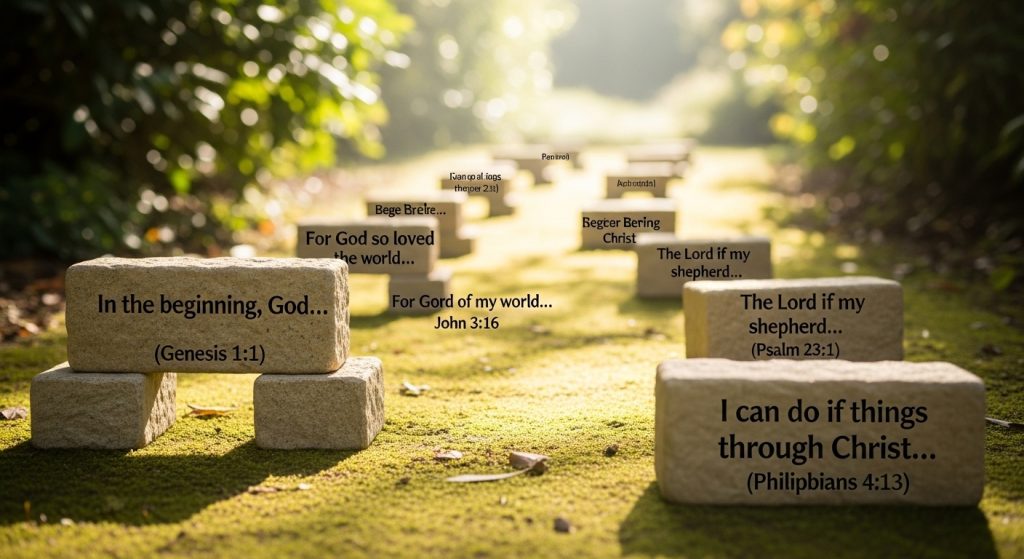
Specific verses serve beginners better than others due to clarity, foundational importance, and immediate applicability to new believers’ common questions and struggles.
Clear and Foundational – These verses use straightforward language explaining essential truths without requiring extensive theological background or cultural context knowledge.
They establish Christianity’s core beliefs: God’s nature, humanity’s need, Christ’s solution, systematically building a comprehensive understanding progressively.
Easy to Understand – Unlike symbolic prophecy or complex theological arguments requiring interpretation, these verses communicate plainly using concrete language accessible to readers regardless of education level, cultural background, or biblical familiarity.
New believers grasp meaning immediately without extensive study aids.
Core Christian Truths – Each verse addresses fundamental doctrines every believer must understand: God’s love, sin’s reality, salvation’s availability, the gift of righteousness, faith’s necessity, living in God’s grace, and the gift of the Holy Spirit, etc.
Together, they form a comprehensive introduction to Christianity’s essential beliefs and practices, creating a solid spiritual foundation supporting lifelong growth.
Best Bible Verses for Beginners

These essential verses provide new Christians with foundational truths addressing salvation, God’s character, practical living, and spiritual growth in accessible, memorable language.
John 3:16 – “For God so loved the world that he gave his one and only Son, that whoever believes in him shall not perish but have eternal life.” Christianity’s most famous verse summarizing gospel message of God’s love, Christ’s sacrifice, faith’s requirement, and eternal life’s promise.
Romans 3:23 – “For all have sinned and fall short of the glory of God.” Universal sin diagnosis establishes every person’s need for salvation without exception or qualification.
Romans 6:23 – “For the wages of sin is death, but the gift of God is eternal life in Christ Jesus our Lord.” Sin’s consequence contrasts sharply with God’s gracious gift through Christ alone.
Ephesians 2:8-9 – “For it is by grace you have been saved, through faith—and this is not from yourselves, it is the gift of God—not by works, so that no one can boast.” Salvation comes exclusively through grace via faith, eliminating human merit.
1 John 1:9 – “If we confess our sins, he is faithful and just and will forgive us our sins and purify us from all unrighteousness.” God’s guaranteed forgiveness upon genuine confession assures guilty consciences.
Psalm 23:1 – “The Lord is my shepherd, I lack nothing.” God’s provision meets every genuine need completely and continuously.
Proverbs 3:5-6 – “Trust in the Lord with all your heart and lean not on your own understanding; in all your ways submit to him, and he will make your paths straight.” Surrendered trust produces clear divine direction through life’s journey.
Philippians 4:13 – “I can do all this through him who gives me strength.” Christ’s empowerment makes impossible tasks achievable through His indwelling power.
Matthew 28:19-20 – “Therefore, go and make disciples of all nations, baptizing them in the name of the Father and of the Son and of the Holy Spirit, and teaching them to obey everything I have commanded you. And surely I am with you always, to the very end of the age.”
The Great Commission establishes every believer’s evangelistic and discipleship responsibility.
Romans 10:9 – “If you declare with your mouth, ‘Jesus is Lord,’ and believe in your heart that God raised him from the dead, you will be saved.” Salvation’s simple requirement—confession and belief—makes eternal life accessible to all.
Psalm 119:105 – “Your word is a lamp for my feet, a light on my path.” Scripture illuminates life direction, guiding daily decisions and long-term direction.
Matthew 6:33 – “But seek first his kingdom and his righteousness, and all these things will be given to you as well.” Priority alignment releases provision automatically as God supplies needs.
2 Timothy 3:16 – “All Scripture is God-breathed and is useful for teaching, rebuking, correcting, and training in righteousness.” The Bible’s divine origin and practical utility for spiritual development.
Joshua 1:9 – “Have I not commanded you? Be strong and courageous. Do not be afraid; do not be discouraged, for the Lord your God will be with you wherever you go.” God’s presence produces courage, eliminating legitimate fear.
Jeremiah 29:11 – “For I know the plans I have for you, declares the Lord, plans to prosper you and not to harm you, plans to give you hope and a future.” God’s plans guarantee hopeful futures despite present uncertainties.
Romans 8:28 – “And we know that in all things God works for the good of those who love him, who have been called according to his purpose.” Every circumstance serves ultimate good purposes for believers.
1 Corinthians 10:13 – “No temptation has overtaken you except what is common to mankind. And God is faithful; he will not let you be tempted beyond what you can bear. But when you are tempted, he will also provide a way out so that you can endure it.” Every temptation includes a divine escape route.
Hebrews 11:1 – “Now faith is confidence in what we hope for and assurance about what we do not see.” Biblical faith definition—present assurance regarding future promises and invisible realities.
Matthew 11:28 – “Come to me, all you who are weary and burdened, and I will give you rest.” Jesus offers rest for exhausted, overwhelmed souls seeking relief.
John 14:6 – “Jesus answered, ‘I am the way and the truth and the life. No one comes to the Father except through me.'” Christ’s exclusivity for salvation—no alternative paths exist to God.
Verses About God’s Love
Understanding God’s love forms Christianity’s foundation. His affection motivates salvation, sustains the believers, and models how Christians should love others sacrificially.
1 John 4:8 – “Whoever does not love does not know God, because God is love.” God’s essential identity is love itself, making compassion His fundamental nature, not occasional mood.
Romans 5:8 – “But God demonstrates his own love for us in this: While we were still sinners, Christ died for us.” Divine love initiative preceded human response or deserving, demonstrating unmerited grace.
John 3:16 – “For God so loved the world that he gave his one and only Son, that whoever believes in him shall not perish but have eternal life.” God’s love magnitude is measured by sacrificing His Son for humanity’s redemption.
Romans 8:38-39 – “For I am convinced that neither death nor life, neither angels nor demons, neither the present nor the future, nor any powers, neither height nor depth, nor anything else in all creation, will be able to separate us from the love of God that is in Christ Jesus our Lord.” Nothing separates believers from God’s love permanently.
Jeremiah 31:3 – “The Lord appeared to us in the past, saying: ‘I have loved you with an everlasting love; I have drawn you with unfailing kindness.'” God’s love endures eternally, never withdrawing despite repeated failures.
Psalm 136:1 – “Give thanks to the Lord, for he is good. His love endures forever.” Divine love’s eternal duration provides security and confidence throughout life’s uncertainties.
Verses About Salvation
Salvation verses explain humanity’s sin problem, God’s gracious solution through Christ, and faith’s necessity for receiving eternal life and forgiveness.
Acts 4:12 – “Salvation is found in no one else, for there is no other name under heaven given to mankind by which we must be saved.” Christ’s exclusivity eliminates alternative salvation paths definitively.
Acts 16:31 – “Believe in the Lord Jesus, and you will be saved—you and your household.” Simple salvation requirement—belief in Jesus—makes eternal life accessible to all people.
Romans 10:13 – “For, ‘Everyone who calls on the name of the Lord will be saved.'” Universal salvation is available through calling on Jesus without ethnic, social, or moral prerequisites.
Titus 3:5 – “He saved us, not because of righteous things we had done, but because of his mercy. He saved us through the washing of rebirth and renewal by the Holy Spirit.” Salvation flows from mercy, not human merit or religious performance.
2 Corinthians 5:17 – “Therefore, if anyone is in Christ, the new creation has come: The old has gone, the new is here!” Salvation produces radical transformation, not mere behavior modification superficially.
1 Timothy 2:5 – “For there is one God and one mediator between God and mankind, the man Christ Jesus.” Jesus alone mediates between the holy God and sinful humanity, eliminating alternative mediators.
Verses About Faith and Trust
Faith and trust verses teach believers to rely on God’s character and promises rather than personal understanding, circumstances, or human wisdom.
Hebrews 11:6 – “And without faith it is impossible to please God, because anyone who comes to him must believe that he exists and that he rewards those who earnestly seek him.” Faith’s absolute necessity for pleasing God and approaching Him acceptably.
Mark 11:22 – “Have faith in God,” Jesus answered.” Simple command establishing faith’s object, God Himself, not faith in faith or positive thinking.
2 Corinthians 5:7 – “For we live by faith, not by sight.” Faith operates independently from sensory evidence, trusting God’s Word over observable circumstances consistently.
Romans 10:17 – “Consequently, faith comes from hearing the message, and the message is heard through the word about Christ.” Scripture exposure produces and strengthens faith systematically and reliably.
James 1:6 – “But when you ask, you must believe and not doubt, because the one who doubts is like a wave of the sea, blown and tossed by the wind.” Faith requires confident trust without wavering doubt undermining prayers.
Psalm 56:3 – “When I am afraid, I put my trust in you.” Fear becomes a trigger for trust rather than panic or paralysis.
Verses About Living a Christian Life
Christian living verses provide practical guidance for daily conduct, relationships, and character development reflecting Christ’s nature and pleasing God.
Matthew 22:37-39 – “Jesus replied: ‘Love the Lord your God with all your heart and with all your soul and with all your mind.’ This is the first and greatest commandment. And the second is like it: ‘Love your neighbor as yourself.'”
Galatians 5:22-23 – “But the fruit of the Spirit is love, joy, peace, forbearance, kindness, goodness, faithfulness, gentleness, and self-control. Against such things there is no law.” Spirit-produced character qualities evidencing authentic Christianity are observable by others.
Romans 12:2 – “Do not conform to the pattern of this world, but be transformed by the renewing of your mind. Then you will be able to test and approve what God’s will is—his good, pleasing and perfect will.” Transformation happens through mind renewal via Scripture, not worldly conformity.
Ephesians 4:32 – “Be kind and compassionate to one another, forgiving each other, just as in Christ God forgave you.” Forgiveness models Christ’s grace received personally toward others who offend.
Colossians 3:23 – “Whatever you do, work at it with all your heart, as working for the Lord, not for human masters.” Divine audience motivates excellence in mundane tasks and secular employment.
1 Thessalonians 5:16-18 – “Rejoice always, pray continually, give thanks in all circumstances; for this is God’s will for you in Christ Jesus.” God’s specific will—constant rejoicing, prayer, thanksgiving—applies universally to all believers.
Philippians 2:3-4 – “Do nothing out of selfish ambition or vain conceit. Rather, in humility value others above yourselves, not looking to your own interests but each of you to the interests of the others.” Humility prioritizes others’ welfare over personal advantage consistently.
Verses for Strength and Encouragement
Strength and encouragement verses provide supernatural empowerment and hope during trials, fears, discouragement, or overwhelming circumstances threatening faith.
Isaiah 40:31 – “But those who hope in the Lord will renew their strength. They will soar on wings like eagles; they will run and not grow weary, they will walk and not be faint.” Waiting on God renews depleted strength supernaturally beyond human capacity.
2 Timothy 1:7 – “For God has not given us a spirit of fear, but of power and of love and of a sound mind.” Fear doesn’t originate from God; He provides power, love, and mental soundness instead.
Isaiah 41:10 – “So do not fear, for I am with you; do not be dismayed, for I am your God. I will strengthen you and help you; I will uphold you with my righteous right hand.” God’s personal promise provides presence, strength, help, and support during difficulties.
Psalm 46:1 – “God is our refuge and strength, an ever-present help in trouble.” Divine presence provides immediate help during crises, not distant observation or delayed intervention.
Romans 15:13 – “May the God of hope fill you with all joy and peace as you trust in him, so that you may overflow with hope by the power of the Holy Spirit.” Hope flows supernaturally through trusting God’s character and promises.
Nehemiah 8:10 – “Do not grieve, for the joy of the Lord is your strength.” Divine joy produces supernatural strength that human happiness cannot generate or sustain.
2 Corinthians 12:9 – “But he said to me, ‘My grace is sufficient for you, for my power is made perfect in weakness.’ Therefore, I will boast all the more gladly about my weaknesses, so that Christ’s power may rest on me.”
How Beginners Can Start Reading the Bible
Starting Bible reading requires practical strategies to prevent it from being overwhelming while establishing sustainable habits that produce lifelong Scripture engagement and spiritual growth.
Start with Simple Passages – Begin with Gospels (Matthew, Mark, Luke, John) before tackling complex Old Testament prophecy or Revelation’s symbolism.
Gospels introduce Jesus directly through accessible narratives requiring minimal background knowledge.
Proverbs offers practical wisdom in bite-sized verses perfect for beginners. The Psalms provide honest prayers modeling authentic communication with God during various emotions.
Read Daily – Establish consistent reading times, morning coffee, lunch break, bedtime, creating habits, and making Scripture engagement a routine rather than sporadic.
Start small, one chapter or even five verses, daily building gradually as capacity increases.
Consistency matters more than quantity; brief daily reading impacts more than occasional marathon sessions, producing burnout.
These daily confessions from the bible establish spiritual foundations progressively.
Reflect and Pray – Don’t just read mechanically, pause after a passage, asking: What does this reveal about God? What does it teach about humanity? How does it apply personally today?
Prayer transforms reading from information consumption into a transformative encounter with God through His Word.
Consider keeping a devotional verse with a reflection journal tracking insights and applications.
Join Community – Connect with established believers through church Bible studies, small groups, or mentorship relationships.
Community provides accountability, answers questions, offers varied perspectives, and prevents isolation during confusion or discouragement.

Other believers’ testimonies demonstrate how Scripture applies practically across diverse life situations, enriching personal understanding significantly.
Use Study Tools – Bible apps with reading plans guide systematic Scripture exposure, preventing aimless wandering.
Study Bibles provide helpful notes explaining cultural context, difficult passages, and cross-references connecting related verses.
Commentaries offer scholarly insights when passages confuse, though beginners should prioritize direct Scripture reading over excessive commentary dependence initially.
Memorize Key Verses – Select 3-5 beginner verses, memorizing through repetition and daily recitation.
Memorized Scripture provides instant truth access during temptation, fear, or crises when consulting physical Bibles proves impossible.
Start with shorter verses like John 3:16 or Philippians 4:13 before attempting longer passages.
Be Patient – Bible literacy develops progressively over months and years, not instantly. Don’t expect immediate comprehensive understanding.
Confusion and questions are normal, healthy parts of learning. Celebrate small victories, understanding one difficult verse, completing one book, recognizing biblical themes, and building confidence gradually through persistent engagement.
Conclusion
Best Bible verses for beginners provide essential foundation stones, establishing a comprehensive Christian understanding without requiring years of study or theological training.
From God’s love and salvation’s availability to practical living guidance and strength during trials, these verses address fundamental questions every new believer asks while remaining accessible through clear, straightforward language.
Start today by selecting five verses resonating with current needs or questions, then memorize and meditate on them daily.
Apply scriptural truths practically through obedient living, prayer, and community engagement, watching how God’s Word transforms thinking, behavior, and spiritual vitality progressively.
Remember that Bible reading isn’t an academic exercise but a relationship-building activity deepening intimacy with God through His revealed truth.
Be patient with yourself, celebrate progress, and trust that consistent Scripture engagement produces mature, confident, victorious Christian living over time.
FAQ
Which Bible book should beginners read first?
When I was born again, I started with the Gospel of John. It was fun to read, used simple language, and had clear theology.
Then I went over to read Mark (the shortest Gospel) and Acts (early church history). Save complex books like Leviticus or Revelation until you’ve established a foundational understanding.
How long should beginners read daily?
Start with 5-10 minutes of reading one chapter or several verses. Quality beats quantity. Brief, engaged reading impacts more than long, distracted sessions.
Gradually increase duration as capacity and interest grow naturally. Consistency matters more than length initially.
What if I don’t understand what I’m reading?
Normal for beginners. Write down questions for mentors or pastors. Use study Bibles with explanatory notes.
Continue reading despite confusion; understanding develops progressively. Some passages remain mysterious even for mature believers. Focus on clear verses first.
Should beginners use specific Bible translations?
NIV, NLT, or ESV work well for beginners, modern language without sacrificing accuracy. If you prefer older English, I recommend you go for the KJV.
Try several translations, comparing how each renders passages, choosing what communicates clearest personally.
How do I remember what I read?
Journal key insights and applications after reading. Discuss passages with other believers, reinforcing understanding through conversation.
Memorize particularly meaningful verses through repetition. Review previously read sections periodically, preventing complete forgetting. Application cements memory better than passive reading alone.

My passion lies in reaching out to young adults in communities and schools, witnessing the transformative power of faith in their lives.
This blog extends my ministry, sharing insights, encouraging believers, and exploring Christ's teachings in daily life.
Welcome, Brother James.
- What Does the Bible Say About Culture and Traditions? - March 16, 2026
- Scriptural Prayers for Pastors and Leaders - March 16, 2026
- 100 Prosperity Scriptures - March 16, 2026